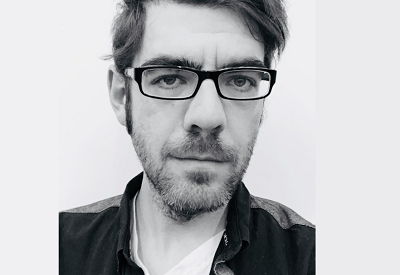
 Michael T. Smith is an Associate Professor of English, where he teaches a range of courses in both writing and film studies. His academic work reflects a strong engagement with contemporary literature and visual culture, bridging critical analysis with creative practice. In addition to his teaching, he has built an extensive publication record, with approximately 300 pieces of poetry and prose appearing in more than 100 journals. His work demonstrates both versatility and consistency, contributing to a wide array of literary publications and establishing his presence across diverse writing communities.
ADHD
I wanted to have a word with you.
It was like a bad movie, made by one of those auteurs;
Or, I forget the term
that I mean to say — it’s the opposite of that,
like a moon to a sun.
Anyway, with mind skipping
like celluloid,
I wanted to focus but couldn’t
Concentrate
But I made a poem as the night played
a trick
on my mind, and so unethically
bound
Every word,
which was chopped up into almost
nothing
and wanting to turn the
leaf
(to leaf through or pull through or whatever I meant to say then)
to cover up the meaning of the word,
to flow down a river as smooth as a glass of wine,
a Cava
from some European winery that I cannot pronounce
even though I idolize the place like a personification
And I
Swerved
to avoid the misunderstanding, did
what I could
to produce
Noise.
Perhaps this is a new thought,
but only to you.
Perhaps
instead, this is an old thought,
For a word I had with you
was steeped in blue,
and as soon as I had it
it bid adieu
to me, but sadly not you.
——-
- ADHD (Originally published in Euphemism in 2018)
Bakku-Shan
I don’t know what your beauty is, but –
Ooo, that snatched me. I was entranced
by only a frame of you.
(Do you judge this?
I’m not alone, and all people should have this freedom – )
Bakku-Shan, meaning a beauty
when viewed from behind
for hotness from the back is the definition
of optimism –
I think.
And if you still feel bad
(despite my best intentions)
then know we never really judge a person,
only parts.
And it’s just like Dali said
while putting drawers on the venus de milo:
the beauty of the femme lies in its mystery.
It —
an object, I understand –
and I don’t mean to offend,
but from behind,
your form’s an ideal of the moment,
your bureau is filled with whispers of secrets
I want to know.
This poem is my secret,
a wink
you can take with you
wherever you may be on your way to go,
or throw away,
as you go
like the dance your hips suggests.
———
- Bakku-Shan (Originally published in Evening Street Press in 2020)
Have you ever?
(A sonnet)
Have you ever cut your words with a splice
by the use of a renegade comma,
have you split the infinitive so nice,
as to blankly write linguistic drama?
Your verse was written in novitiate;
Do you wonder ‘if a passive voice mess
was written by you?” – a’ Midas vitiate.
Do you think your errors are somehow less?
Or haphazardly using an em dash —
you need training how to hold your pencil
if you would punctuate by means so rash,
not only use adverbs, but the -ly kill!
Did you ever – I can ever exclaim —
Reflect on your poor language, that you maim!
———
- Have you ever? (Originally published in BlogNostics in 2018)
Emily Dickinson’s Dashes
I mean – oh my – “He aven”
God! Have you read a poem —
By Emily Dickinson? It’s like she’s the almighty
Typographer. With dashes more important than
Punctuation – or word choice. She –
Clearly one without an auto-format –
Just went nothing but nuts—
With the dashes, I mean – not
Her — actual — mental illness –
These lines, these –
Are like giggles, filling a page madly –
A page that never really ends –
——
- Emily Dickinson’s Dashes (Originally published in Vox Poetica in 2017)
‘Teh’
E’ry time I type up a poem
Of moored and sandy thoughts
My fingers dance on loan
And renegades they be,
type a peculiar word –‘teh’
From where is this word
Of homeward thoughts?
to free said convicts
from out their prison stick.
Is a sign of my aging years
of arthritic fingers stumbling
in the Ben Hur of typists,
whose Roman numerals are bloated.
Or is it born of the unconscious —
in that loom of the mind,
where weaves an Arachne able,
entangling thoughts in their way.
Is it something to be deciphered —
a code (like most of poetry)
to bury in a ‘t’ the crossword
title, beyond letters hyetal?
Might it be some slang,
written on a slant,
to boorish hours
of morning all alone.
Yet in this monstrosity
something touches my soul –
not only the words we teach,
but even ‘teh’ bloated things
we mispronounce.
——-
- ‘Teh’ (Originally published in WINK in 2018)
 The Galway Review