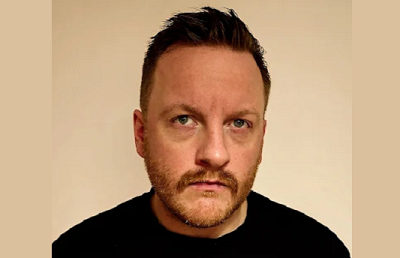
 Rickie O’Neill is a 35 year old writer, actor, director and musician originally from Claremorris, Mayo, currently residing in Galway. For the past 13 years, Rickie has been a session musician and full-time drummer for the Irish band The Saw Doctors. In 2015 he changed his course slightly and began writing, starting off with short film scripts and poetry (which he still enjoys writing very much to this day). In 2017 he took a keen interest in the short story form and was particularly impacted by how powerful a short story can be as opposed to a long-drawn-out novel. Plus, you finish them quicker. Rickie’s writing influences include Anton Checkov, Roald Dahl, George Saunders, Lafcadio Hearn, Chuck Palahniuk, Anthony Bourdain, Mike McCormack & Donal Ryan. Last December, Rickie released his first self published novella called Little Sickos, under the pseudonym Fionnain J McKeon, and in March 2026 he released his first anthology under the same name titled ALIVE ALL NIGHT, which can be purchased from Rickie/Fionnain directly by emailing: saltedstrings@gmail.com
THAT TIME IN KILLNAFADÍ
By Rickie O’Neill
The island’s oldest resident, a lady named Nora McDaid, says that for as long as she can remember, foreigners have been slumping like bloody termites onto the land in their hundreds and thousands, every single year, just to get a “better view for themselves” or a crack at that elusive “photo opportunity”.
“Keep off’a me shrubs ye filthy little pricks.” she can be heard saying. “I’m only after watering them begonias. Leave them alone will ye, for Christ’s sake.”
To which the perpetrators would occasionally reply, often with incessant genuflects: “We so sorry madame. Forgive us. We did not’a see. I swear, I swear we did not’a see.”
Even on a bad weather day, if you were stupid enough to take yourself out to the cliffs, and if you stood right there, right at the edge, and looked out, way, way out, chances are you’d see it, quite clearly, the jagged outline of Bora’s Old Lighthouse getting thrashed by the waves. The iconic landmark, named after local heroine Bora O’Donnell in 1503, sits, resting, about a kilometre and a half off the coast of the island and has been, for centuries, a notable site of interest for those who come to visit the village.
“They come in all shapes and sizes these people” says Nora. “And all flippin colours too. Just to drink our Guinness, scale our hills, take pictures and pass remarks on that FECKIN THING way out there in the water. CALL ME ODD BUT I SIMPLY DO NOT GET IT.”
On the other side of the island, and meanwhile, the local men of Killnafadí, all one hundred and eight of them, are famed the world over for their own ‘better standing’ views on the matter, saying that “If it wasn’t for the Big Bora Lighthouse out there in the mist, the history behind it, and how it draws people of all shapes in, this little commune of ours would be sank to the bottom of the ocean a long, long time ago.”
“Hear, hear. . .”
“Just like that.” they’d say. “We’d be another lost civilisation and that is a fact. Frozen in time. Frozen for good. Or for God knows how long. With only a few small clues remaining in our wake to suggest that we even existed at all in the first place. Like Atlantis we’d be, the greatest of all the lost cities, only –
“Much more poetic and endearing of course.”
When asked about Nora, the men of Killnafadí spoke at length about her, the issue she has with the Lighthouse and the people that do be drawn to it, saying that it has, for decades now, been this way. That it is an issue full of both immense entertainment and immeasurable scorn.
“It keeps her heart ticking over.” they say. “The woman, God bless her, hasn’t much left to live for. At 104, she loves a good fuss, or a scrap, and can pride herself far too often on being a dangerous sort’a thing. But it’s all nonsense.”
A recent article in The Island Chronicle recorded the woman during one of her bashings where she ripped the island’s tourism sector apart; claiming that she couldn’t sleep at night out of fear. That she was being coerced and bribed constantly, day in day out – by the board members. In this, she demanded police intervention, claiming that they (the board) had wanted her dead.
DEAD.
And that it was all government approved, all above board, just so they could retrieve and use the small bit of land she had for their own profit.
“They want to build a gift shop where my house is.” She’s recorded saying this. “Well they can go and shite if they think that’s happening. No way José. Not a hundred men would have strength enough between them to take me out of here, and “That’s the fucking truth.”
In the same hit piece, steadfast Nora is further recorded saying, and I quote, that “The American people for instance, in her experience, were the worst people in all the world, more than Hitler, and that they shouldn’t be allowed onto commercial planes let alone another person’s island.”
But at the same time, to quote once more “AND THAT GOES FOR EVERYBODY.”
“They are gruesome.” she’d say, making one outlandish claim after another. “THE WHOLE STINKIN LOT OF THEM. All they want to do is gape out at the monstrosity from the mainland, clumped into their groups, like fatties, eating shit, and saying stupid things to one another.”
When pressed on the matter further, Nora said she couldn’t be dealing with those terrorists no-more. Not at that tender age. The fact that she was 104 years old, and living by herself. . .she felt an injustice in the world. Like she wasn’t being well protected.
“These strangers.” she said. “They might as well come into my damn house. Right through my front door and make tea for themselves. And a few biscuits. This is exactly the way it’s going around here. Especially for me. I have no protection whatsoever.”
She said “I’m merely a loose dinghy in the open ocean.”
These bold assertions would cause ructions on the island after a day or two, with fellow islanders coming forward in their droves, furious men and women, saying that “She HAD indeed been very well protected, and that all of the day’s drama (from her) had stemmed solely from basic feckin jealousy and nothing else.”
“That’s all it is. . .” they said. “Outright jealousy.” “Jealousy?”
“Yes. Are you blind as well as stupid?”
“The fact that a dead woman. . .” they’d argue. “An almost mythical creature, could be out here, in this day and age, getting more attention and love than her has put her sense of self, and her ego, into a right good spin.”
For islanders to say something like this, to sink so low, both morally and everything else, before a local elder, was forever deemed the ultimate failure in life.
Like losing a child.
Or worse than that.
And could be the very thing, in the end, that would see the poor woman to her downfall.
“We’ll just have to wait and see.” they all said at an AGM. “At this point, she’s nothing but a hazard to herself, everyone else, and is liable to do absolutely anything – anything – and if that’s what growing old is all about then we absolutely want nothing to fucking do with it. So Nora,” they said.
“What do you think’a that?”
“Not much quite frankly.” she eventually replied, sitting back into her chair. “It’s actually kind of amusing for me that, for the amount of you in it, there’s not a single brain between you all. And yes,” she said, snapping her fingers and pointing at her cup. “I will have another tea. The flavour is good and much different from the stuff I do get.”
 The Galway Review