Farhang Book Two
Author: Patrick Woodcock
Reviewed by Arthur Gerould
Publisher: ECW Press, Toronto, Canada, 2026
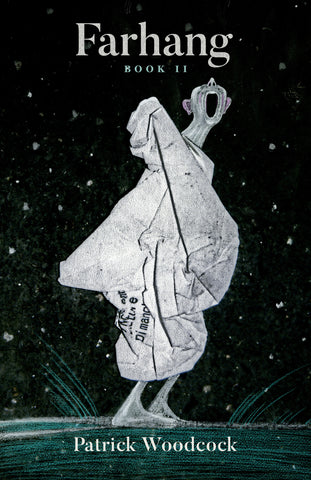 Farhang Book II, Patrick Woodcock’s eleventh book of poetry, is a striking and immersive collection that moves with rare confidence between geographies, inner weather, and moral tension. Built on a disciplined structure yet alive with restless motion, the poems carry the reader across ice, sea, and memory, where landscape is never passive. It presses back, shapes thought, and demands a response.
What stands out immediately is the book’s ability to fuse physical terrain with psychological urgency. The Arctic, more specifically Nunavut, is not described so much as experienced. It becomes a testing ground for perception, endurance, and moral pressure. In one of the collection’s most resonant passages, Woodcock writes:
“You wanted an ocean of your own,
enough wind to make it sway,
while you stood and tried to swallow the one thought
frozen deep within your throat.”
This moment captures the essence of the book. Desire, isolation, and confrontation with the self are braided tightly together. The imagery feels both immense and precise, with lines that expand outward into sky and sea while remaining anchored in the body.
What distinguishes Farhang Book II most clearly is how decisively it departs from Farhang Book I. The earlier volume moved outward, driven by encounter, travel, and accumulation. Here, the motion tightens. The poems return to a single terrain and press into it, testing its limits. The result is a collection that feels more austere, more controlled, and more internally driven. Where the first book sought to gather, this one seeks to endure. Where the earlier voice travelled, this one remains and reckons.
There is also a tonal shift. Farhang Book I carried a sense of discovery, even when shadowed. Farhang Book II questions the act of witnessing itself. The speaker is no longer just moving through landscapes but is implicated in them, burdened by what has been seen and is being currently seen and recorded.
That burden is rendered through a remarkable command of rhythm. The lines move with a steady, almost tidal force, allowing imagery to accumulate and break with precision. As Woodcock writes:
“You admire the surge of a wave-riddled ship
shunting history to widen the darkness,
and the whip of the deepwater ploughman,
the wooden draft horse striving toward Hill Island
as morning falls in dark strips along the bay…”
Here, the flowing rhythm carries the reader forward, each line extending the last, building momentum before settling into a darker awareness. It is a technique used throughout the collection, one that gives the poems both propulsion and weight.
There is a consistent refusal to romanticize. Beauty appears, but it is edged with fracture. The environment shifts quickly from vast openness to threat, as seen in the stark realization:
“There would be no growth, no flowers, no markers—
and soon, no light.”
This tension gives the poems their force. The reader is never allowed to settle. Movement is constant, whether across frozen ground or through shifting emotional states.
Another poem deepens this trajectory, turning outward observation into introspection. The recurring image of the struggling vessel becomes a quiet but powerful metaphor for guilt and human limitation. The question lingers:
“What have you done but watch and record plodding vessels?”
Stylistically, Farhang Book II is disciplined without ever feeling constrained. Each poem remains fixed at 28 lines, yet the pacing is deliberate, the imagery assured, and the movement of the language feels inevitable. There is a strong formal intention beneath the surface, but it never overshadows the emotional force at the centre of the work.
What ultimately makes this collection so compelling is its sense of reach. Written in Iqaluit, Nunavut, these poems contain lived impressions drawn from more than fifty countries Patrick Woodcock has lived in or visited. Yet they are never content with simple observation. They test the limits of what can be held, named, or endured. They move between solitude and responsibility, between the act of witnessing and the burden of it.
Farhang Book II is a deeply engaging and thoughtful work. It confirms Patrick Woodcock as a writer capable of transforming stark landscapes into spaces of reflection and tension, where each line feels earned and necessary.
Reviewed by Arthur Gerould
 The Galway Review