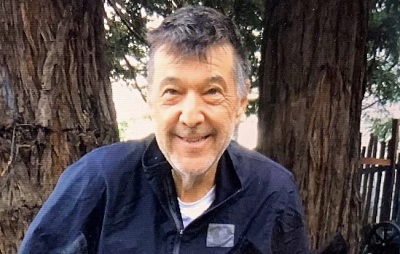
 Mark Sanford Gross is a writer and community storyteller based on the Northern California coast. He co-stewards Ulysses in 80, a global reading of Ulysses, and is the founder of Write Up the Coast, a project focused on connecting people through shared stories and conversation.
I Didn’t Know What a Fada Was
By Mark Sanford Gross
I’ve never been to Ireland.
Not in the passport-stamped way.
I’ve never stepped onto the pavement of Dublin.
Never opened a shop door, never stood waiting for a bus, never heard the jangle of a bell as someone walked in behind me—
the sounds of voices slipping out into the street, laughter, a quick word here, something carried and gone.
And still—
I’m there every day.
The first time I read Ulysses, I was trying to get through it.
Like a task.
Like something to check off.
I carried the book the way you carry something you want to be seen with.
Not just a book—
a way of saying something about who I was,
or who I thought I was.
I finished it.
I thought that was the point.
It wasn’t.
Because somewhere along the way, something shifted.
I thought I was entering the language.
Somewhere along the way,
the language entered me.
Not all at once.
Not in a way I could explain.
Just—moments.
A museum in Washington, D.C.
Room after room of history I didn’t fully know how to take in.
And then—off to the side, a small placard.
An Irish name.
Roger Casement.
I didn’t know his full story.
But I knew enough.
A man executed—
not just for what he did,
but for who he was.
A man who tried to free people from brutality.
A man whose own words were kept from the public.
And a man who wanted, simply,
to love
and be loved.
There’s a line of his I carry—
something about only those who have loved knowing the pain of it.
I don’t quote it exactly.
But it stays.
I didn’t even know he was in Ulysses.
Not at first.
I found him somewhere else—
and stayed with him there.
And then later—
back in the book—
a passing line.
What’s his name… Casement… he’s an Irishman.
Easy to miss.
But there he was.
As if he’d been there all along.
And something in it—
brought back a line from Ulysses:
pain was not yet the pain of love.
It passed through.
And stayed.
It felt given.
I didn’t ask why.
I didn’t need to.
Another morning.
Walking my usual path along the bluff—
on the Northern California coast—
that edge where the land gives way and the ocean takes over everything.
There’s an old-growth grove of cypress trees just before it opens out.
Trees that feel older than they should be.
Bent.
Weathered.
Still reaching.
Sometimes it feels like they’re trying to wrap themselves around me.
That day I’m listening to Ulysses.
Deep in Cyclops.
The part people say you can just move through.
Lists.
Endless lists.
And then—one line:
Woodman, spare that tree.
I stop.
Because in front of me—
there it is.
One tree among the others.
Bent.
Holding on.
Reaching.
As if it’s pointing something out to me.
I stop—
to let it.
To listen.
Later I learn the line comes from an old poem.
A plea to spare a tree planted by someone long gone.
But in that moment, I didn’t need to know that.
The line had already done its work.
It had found me.
It kept happening.
Scenes I couldn’t quite place myself inside—
until they opened somewhere else.
A priest passing boys in a field.
A thought about who is saved and who is not.
And then—
something interrupts my listening.
A new alert.
A shooting.
A school in Texas.
Children.
I’m standing still.
And somehow, the echo of that earlier scene is still there—
not explaining anything, not resolving anything—
just…present.
And then something smaller.
Almost nothing.
I’m writing an email.
A name.
It gets corrected.
Not by me.
A mark I didn’t see.
A mark I didn’t understand.
And suddenly I realize—
how something so small
could matter so much
to someone I care about.
How not seeing it
could feel like not seeing them.
I didn’t know what a fada was.
And that’s when it lands.
I’ve been working alongside people for years.
Reading their language.
Saying their names.
Walking their streets—in the only way I know how.
And I didn’t know this.
But I was still there.
And then—another moment.
One I didn’t see coming at all.
Leopold Bloom—
moving through the day,
thinking, watching, carrying everything quietly.
And then I realize—
he’s an ad man.
I stop.
Because that was me.
Years of it.
Sitting with clients, talking about placement—
where something should appear,
what it should sit next to,
what it should be near.
The same conversations.
The same instincts.
And here he is—
on the page—
long before me.
I didn’t go looking for that.
But it found me.
Another moment—
where the book seemed to know
something about me
before I said it out loud.
That’s what I’ve come to understand.
You don’t read Ulysses and put it back on the shelf.
You move through it—
trying to understand,
holding the thread,
staying with the rhythm—
and every so often
something lifts.
A line here.
A name there.
Not everything.
Not even close.
Just enough
to stay with me.
Ulysses holds something like 265,000 words.
I move through them—
trying to follow,
trying to stay,
trying to hear what I can.
And every so often—
a handful rise up.
Not all at once.
Not in any order I understand.
Some stay quiet.
Some disappear.
And some—
I realize later—
were never gone at all.
Just waiting.
Waiting for a moment
I didn’t know was coming
I’ve never been to Ireland.
Ireland comes to me
when I’m not stopping to take note—
not of what’s around me,
not even what’s going on inside me.
Just moving.
And maybe that’s what it’s given me—
not answers.
But a way to feel my way through
the thoughts as they come.
To let them arrive
when they do.
Without asking why.
And maybe that’s enough.
 The Galway Review
Absorbing poem! A stream of consciousness, but of course, now where’s my copy of Ulysses?
“I’ve never been to Ireland.
Ireland comes to me” . . .
Very sweet. Ireland comes to me, too.
This is beautifu! I especially love the idea that we think we are entering the language, only to realize the language has entered us. That feels deeply true of Ulysses. The novel has this uncanny way of weaving itself into ordinary life. It winds its way into art, memory, names, chance encounters, even the landscape around us until the world itself begins to feel Joycean. Thank you for sharing such a thoughtful reflection. <3