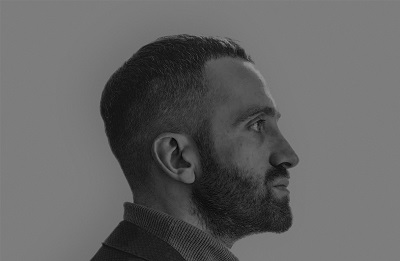
 Gabriele Carù (b. 1984, Milan) is an Italian poet and designer. Having lived and worked in Berlin, Dublin, and London, his writing dissects the fragility of contemporary life, exploring themes of digital alienation, the commodification of relationships, and the persistence of human connection.
Tito and the War in Bergamo
High I fly, helpless to everyone and everything, observing from on high the earth that turns and the motion of the World that overwhelms life.
The rock flanks crumble struck by lightning, and the wheat expanses, just below, fall scythed down by man’s progress, by his mechanics of war.
Meanwhile great rains mount, rivers swell, the embankments give way and with them our safe houses.
Far from the call of shots, from their soft and pungent smell, from their fast and imbecile course, I observe with peremptory eye man busying himself.
I observe him first polish, then load a rifle; first leave the house, then shoulder it, take aim and again, and again shoot but without reaching me, for I am sky.
I must wake up, rouse myself, it is now evening. I have flown all day but I am still wet, wet and tired.
I lift my wings and reveal a red garment I remember never having worn, but it is late by now and God has, like a cold and dry wind, put me to sleep.
Our New Body Electric
Love and violence I sing, and even if the batteries run dry, mine never will.
I sing the body electric, with the aftermath devastated, fabulous here and there with alcohol, filth in the veins, the headache filling what seems empty.
I drive and I swerve.
How much it costs to be professionals, and how much to be so at work, how much on hot days, when among kids nagging uselessly.
It will serve no purpose, it will not serve to save us.
I would like to fall asleep for a long time and alone in a park, amidst the pigeon shit falling, while chefs capture some and eat their bodies.
Leone
I am your hut, my love. Enter, and do with it what you will. Detach and destroy, burn and scatter what I have gathered; pay no mind.
After all, I would do the same, were I visiting, a guest one day in yours. I would spare nothing to leave you everything,
in the instants in the moments in which your body and mine struggle to decide who will sit on the high chair.
My adult body represents its strength and its decline; yours, still, its rebirth.
It is a burning countryside. After the war, houses burn too.
Our contending the few tired mules, among abandoned armaments, extremities painted blue, the color of abandonment.
Our body is an asset, and life a contract with an expiry date.
Mirages
We are a county of the desperate, of the poor who, with their malnourished horse, with their own bruised legs, chase a castle and its redoubt of sovereignty, ever more distant.
To be poor today is never true. They hang from streetlamps, lying on the streets, limping like invalids, all around beaches, beaches of satisfaction.
Sweet undertows and moans for our body, swollen and white, paused for the seagulls, and more akin to that of the jellyfish lying beside.
Poor for accepting promises instead of facts, pieces of technology corroded by salt and applications that can no longer function.
Epitaph
Remember what I was in life, before it happened that a clear sheet, then a spent sun, like me as well, disillusioned and tired, overwhelmed me.
For a rule prevails whereby everything returns: my body will return to the earth, my spirit to the sky, along invisible currents, pushed by others, some held back and some let go by the living.
The most helpless evil would wish that, weapons surrendered, we disperse at random on the crests of mountains, or in the wastelands just below, wide open.
 The Galway Review
Poems that packs an emotional punch with electrical words, disconnected, reconnected, connected as we are in a ‘technological’ melancholy. It’s a vivid reflection on what it means to stay human when our surroundings feel increasingly artificial and disconnected. Really really interesting and profound.