 Professor Petar Penda is a translator, critic, and poet teaching English literature at the University of Banja Luka, Bosnia and Herzegovina. He holds a PhD in English and American Modernism. Penda has authored critical monographs, translated over a dozen books including the EU Prize-winning Since I Bought a Swan (Ballerini Book Press, 2024), and published poems and translations in journals including The Galway Review. His work spans modernist scholarship, contemporary poetry, and literary translation.
Concrete Blues: On Building, Ambition and the Limits of Seeing
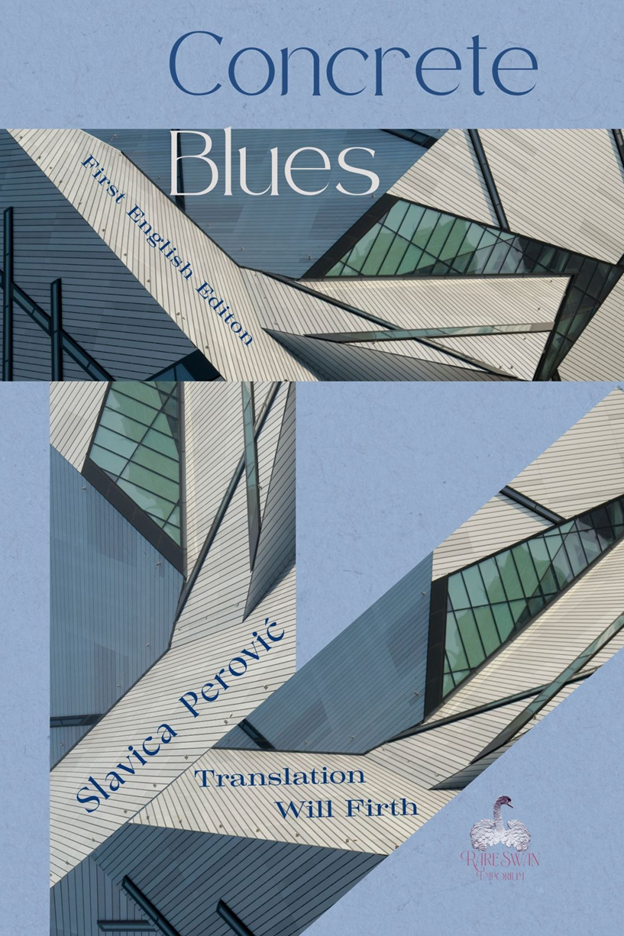
(Slavica Perović, Concrete Blues, Ballerini Book Press, 2026)
A Review by Professor Petar Penda
There is something deceptively stable about the world Slavica Perović constructs in Concrete Blues. Buildings rise, deals are made, most structures hold, one ceiling collapses. Yet beneath this apparent solidity runs a quieter instability, ethical, emotional, and perceptual. Nothing collapses outright. Instead, things shift, almost imperceptibly, until what once seemed firm begins to feel uncertain.
Set within the world of construction companies and their investors, the novel traces a system governed by profit and sustained by fragile alliances. Relationships are often transactional, shaped less by affinity than by necessity. And yet, Perović resists reducing this world to a simple critique. Her characters are neither wholly complicit nor entirely resistant. They occupy an uneasy middle ground, where intention and action rarely align and where compromise arrives gradually rather than all at once.
At the centre of this shifting landscape stand Viktor and Marija, figures who initially appear to embody clarity, moral, emotional, even aesthetic. Their presence introduces a counterpoint to the surrounding world, one that gestures toward the possibility of a different way of living. But Concrete Blues is not interested in preserving such clarity. What unfolds instead is a slow negotiation with reality, where ideals are tested not through dramatic rupture, but through a series of small, cumulative adjustments.
Viktor is perhaps the most revealing figure in this regard. His outward openness suggests transparency. Yet the novel complicates this surface, hinting at a depth that resists easy interpretation. There is, as Perović suggests, a boundary beyond which perception falters. We see enough to recognize, but not enough to understand. Viktor’s trajectory unfolds within this tension, as both the character and those around him struggle to see beyond what is immediately visible.
If Viktor represents the limits of perception, Petar, the novel’s central antagonist, embodies the excesses of ambition. He is not a simple figure of moral failure. His dedication to his work is rendered with seriousness. Construction becomes more than a profession. It becomes a form of self-articulation. The building process acquires an almost metaphysical dimension, as if constructing external structures were inseparable from shaping an inner one. Yet this ambition proves unstable. As his influence diminishes, Petar is forced into a confrontation not only with the world around him, but with the limits of his own self-conception.
Architecture in Concrete Blues functions as more than setting. It is a conceptual framework through which the novel reflects on value, both aesthetic and moral. Contemporary buildings, often stripped of artistic intention, become expressions of economic constraint. Investors dictate form. Architects adapt. In this dynamic, beauty is no longer independent, but negotiated, reduced, and sometimes erased.
The novel’s imagery frequently condenses this condition into striking formulations. At one point, the city appears as “a gang-raped woman, with a brood of concrete brats as a result”. Elsewhere, the logic of construction and collapse is captured with unsettling clarity: “Let’s build, as long as we don’t collapse afterwards”. These moments are not decorative. They reveal the underlying grammar of the novel’s world, where creation and destruction remain inseparable.
The title itself encapsulates this tension. “Concrete” suggests weight, permanence, inevitability. “Blues” introduces a quieter register of suffering, a personal endurance within impersonal systems. Together, they evoke a world in which external structures press upon internal lives.
Perović’s prose moves between precision and lyric intensity. Her background in metaphor is evident, yet the language does not overwhelm the narrative. Meaning accumulates gradually. Dialogue, in particular, reveals the novel’s attentiveness to what remains unsaid. Conversations often unfold on the surface while their deeper implications remain just out of reach.
A crucial dimension of this English-language edition is the translation by Will Firth. It succeeds not only in conveying meaning, but in recreating the tonal and rhythmic fabric of the original. The particularities of Montenegrin cultural context are rendered with sensitivity, without being flattened into familiarity. What is especially striking is the preservation of sentence rhythm and metaphorical density, elements that often resist transfer across languages. Here, they are carried over with a fluency that feels both natural and carefully wrought.
What lends Concrete Blues its force is the breadth of its concerns. Alongside ambition and profit, the novel engages questions of love, power, and social expectation. These themes are not separate strands, but interwoven elements of a single reality. The novel does not resolve them. Its characters arrive not at clarity, but at recognition, often painful, often incomplete.
In this sense, Concrete Blues invites a reflective form of reading. As the characters confront their own limitations, the reader is drawn into a similar process. The novel does not instruct, or moralize. It exposes, gradually and with restraint, the structures that shape both individual lives and collective experience.
What ultimately distinguishes Concrete Blues is its literary control. Its richness does not come from excess, but from the careful orchestration of image, rhythm and perspective. Perović manages to sustain a complex, multi-layered narrative without losing coherence or emotional precision. The result is a novel that is at once intellectually engaged and sensuously written, grounded in a specific cultural context yet unmistakably universal in its reach. It is this balance, between structure and instability, thought and feeling, that secures its place as a work of lasting literary merit.
 The Galway Review