 Professor Petar Penda is a translator, critic, and poet teaching English literature at the University of Banja Luka, Bosnia and Herzegovina. He holds a PhD in English and American Modernism. Penda has authored critical monographs, translated over a dozen books including the EU Prize-winning Since I Bought a Swan (Ballerini Book Press, 2024), and published poems and translations in journals including The Galway Review. His work spans modernist scholarship, contemporary poetry, and literary translation.
Between Voices and Silences: On Translating Tanja Stupar Trifunović’s Clocks in My Mother’s Room
A Review by Professor Petar Penda
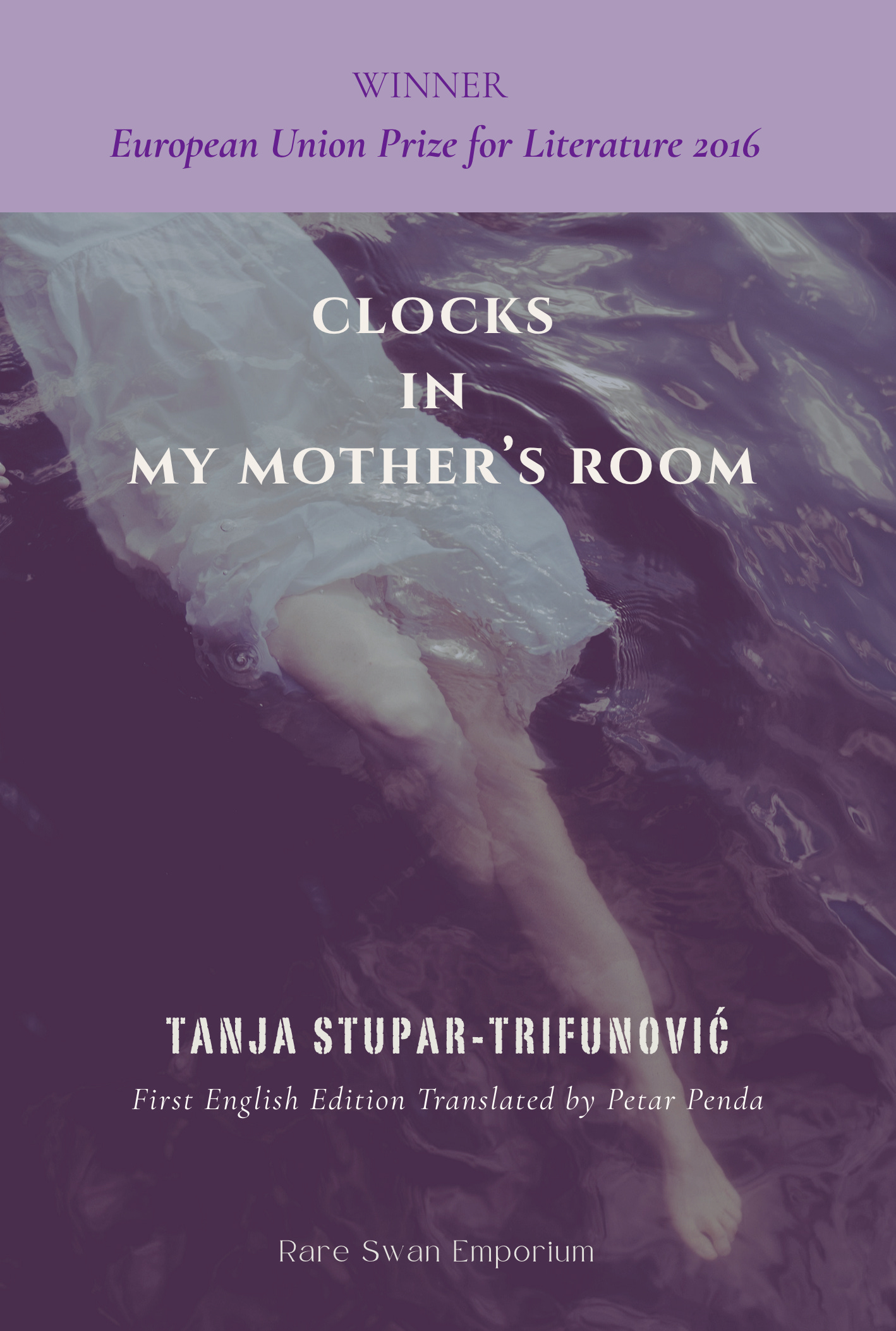
Clocks in My Mother’s Room by Tanja Stupar Trifunović is a lyrical and haunting novel that delves into the intimate terrain of memory, inheritance and womanhood. It tells the story of three generations of women, grandmother, mother and daughter, whose lives mirror and echo one another across time. Through their intertwined consciousness, the novel explores silence and trauma, exile and return, love and surrender. It is a story about the ways women inherit pain and desire, how they carry each other’s unlived lives, and how language and memory can both wound and heal.
Translating Clocks in My Mother’s Room from Serbian into English was a journey through mirrors, voices and invisible thresholds, a journey that asks not only for language but for breath. The novel itself is an echoing house, full of rooms whose doors open into other generations, and the act of translation became for me an act of walking through that house in the dark, guided by a single flame, careful not to extinguish it while lighting one room after another.
At the heart of the book lies the fluid movement of consciousness, the subtle, shifting current that passes between mother, daughter and grandmother, as if one pulse were running through three bodies. In the original, that current is elusive, suspended between memory and dream, between speech and silence. The greatest challenge was to preserve that shifting voice, to make the reader sense, almost physically, the moment when the “I” of the daughter becomes the “I” of the mother, when the mother’s thought seeps into the grandmother’s memory, and when all three voices finally merge into one interior sea.
English, unlike Serbian, struggles to hold such fluidity. It prefers a strict, more defined syntax, punctuation, and closure. But this novel rejects closure. It is a text of permeability, of inherited emotion, of voices seeping into one another like water through cracked earth. Translating it meant loosening English itself, allowing it to drift and breathe, to become porous and more musical. Often, I had to stand quietly at that delicate border where meaning begins to dissolve into rhythm, and trust the rhythm more than certainty.
There is something almost sacred in that act: listening to a consciousness that is not linear but tidal. It rises and falls, it remembers before it speaks. I sought to preserve the echo of a daughter remembering her mother’s silence, of the mother inheriting her own mother’s sadness, of generations speaking through one another without knowing where one ends and the other begins. The translation had to breathe with the same rhythm, the rhythm of the sea, of grief and birth.
Reading and translating Clocks in My Mother’s Room is a profoundly emotional experience that transforms the translator and the reader from observer to participant. The novel vibrates with poetic intensity and its sentences are alive with contradictions: tenderness and cruelty, fatigue and wonder, realism and revelation. Its beauty lies not in serenity, but in turbulence, in the collisions of images and the quiet tremors of recognition we feel while reading.
To bring this into English was to risk immersion, to drown a little, to resurface, and to learn how consciousness itself translates from one heart to another. In the end, I understood that translation, like the novel, is about love’s persistence through distance, about how the words of one woman, spoken decades ago in another language, can still stir in us the same ancient longing to speak, to remember and to forgive.
Critically, Clocks in My Mother’s Room has been recognised as one of the most powerful and original achievements in contemporary European literature, having won the European Union Prize for Literature in 2016. It stands out for its fusion of poetic language and narrative intensity, for the way it explores personal and collective memory through a deeply feminine and universal lens. Critics have praised its delicate weaving of prose and poetry, its fearless confrontation with emotional inheritance, and its hypnotic rhythm that merges introspection and storytelling. It is a novel that demands attentive reading and rewards it with the quiet astonishment of truth revealed through beauty—a text that continues to echo long after the last page is turned.
 The Galway Review