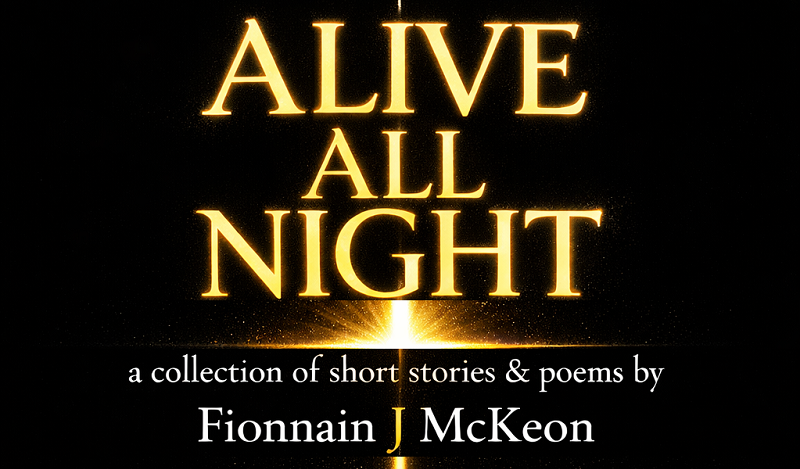
The Noise Within the Silence: On the Restless World of Alive All Night
Review by Dr. Annand Goldsmith
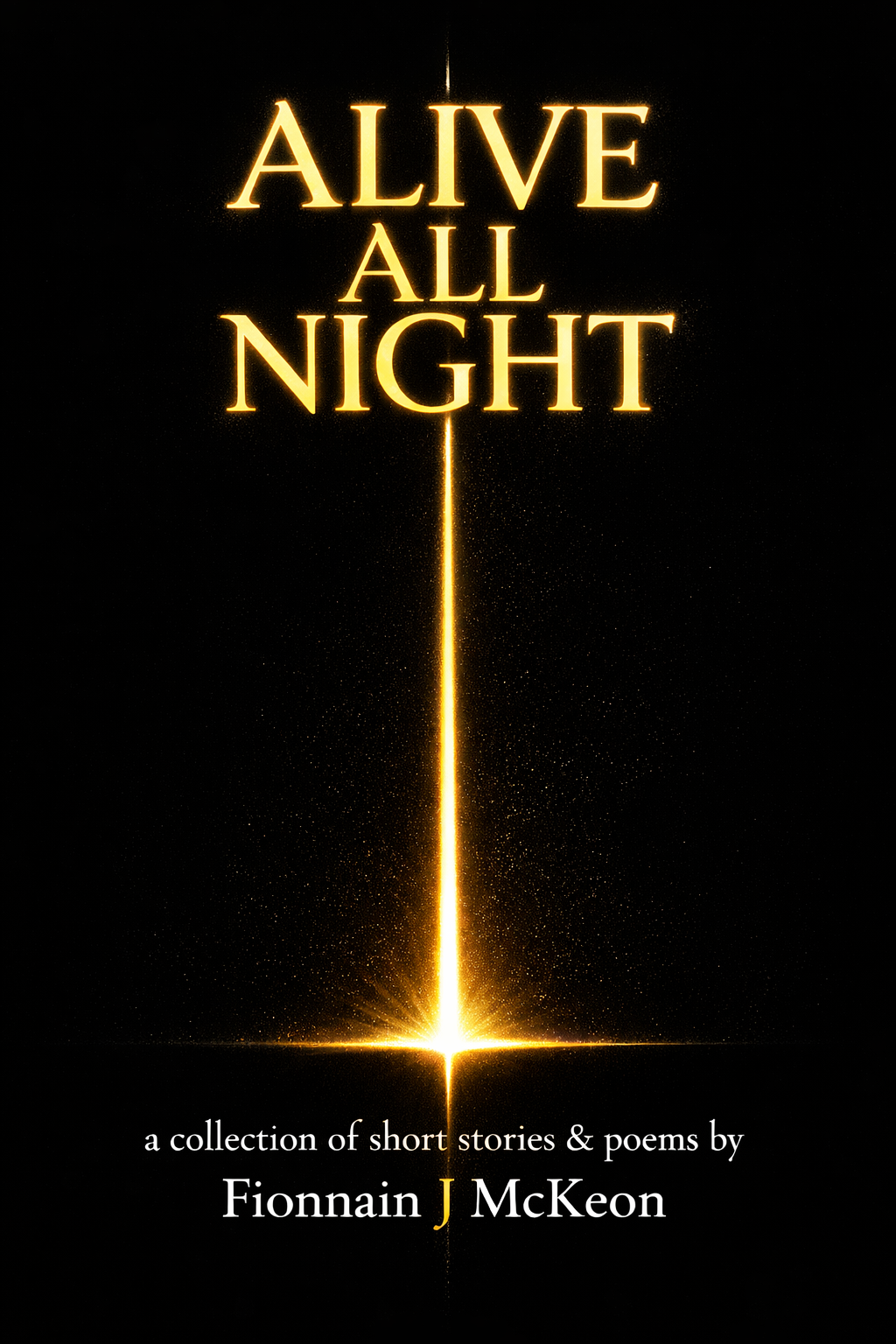
Alive All Night (a collection of short stories & poems by Fionnain J McKeon) is a raw, unfiltered, and stylistically audacious collection that situates itself somewhere between a fragmented novel, a sequence of prose-poems, and a series of monologues shaped by memory, alienation, and masculine interiority.
What distinguishes this work immediately is its refusal to conform: linguistically, structurally, and morally, it resists polish in favour of immediacy. The result is a text that feels lived-in rather than composed—urgent, abrasive, and at times disarmingly tender.
The opening piece, An Old Harbour Town, establishes the tonal architecture of the book. Here, isolation is not merely geographical but existential. The unnamed narrator wanders through a coastal setting where silence becomes a kind of antagonist. The prose oscillates between lyrical description—“spiced port and salt, with mild wafts of excrement”—and interior fragmentation, capturing a mind teetering between boredom, unease, and a strange, reluctant contentment. This tension between dissatisfaction and fleeting peace becomes a recurring motif throughout the collection. The narrator’s self-questioning—bordering on paranoia—introduces a psychological instability that deepens the emotional stakes of even the most mundane observations.
The subsequent vignette, Anyone There? No, sharpens this sense of desolation through stark minimalism. Its stripped-back language and repetitive imagery of empty roads, rotting infrastructure, and silent landscapes evoke a post-apocalyptic mood, only to undercut it with a darkly comic reveal: this is simply rural Ireland. The tonal pivot here is significant. It demonstrates the author’s ability to balance bleakness with irony, exposing how perceptions of emptiness are often subjective, shaped as much by expectation as by reality.
One of the most compelling pieces, Farm House in the High, introduces a quasi-mythic dimension through the figure of “Ginger,” a struggling child whose efforts to retrieve a bicycle become emblematic of perseverance. The narrative voice here is more observational, almost godlike, yet tinged with cruelty—describing the boy as “Helpless and Worthless and Doomed.” This harshness is later complicated by the boy’s resilience, rendering the initial judgment suspect. The closing sequence, in which the boy’s physical traces are erased by rain, becomes a powerful meditation on impermanence and the fragility of human effort.
The collection frequently pivots between such lyrical passages and more grounded, often coarse narratives. Jesus for a Day is a striking example, blending childhood innocence with irreverent humour. The narrator’s attempt to construct a crucifix and stage a backyard reenactment is both absurd and oddly sincere. The piece captures the imaginative intensity of youth while simultaneously undermining it through self-awareness and comic deflation. This interplay between earnestness and mockery is one of the book’s defining strengths.
However, it is in Liquor, Guns & Ammo and the extended Little Sickos section that the text becomes most confrontational. Here, the language turns aggressively vernacular, saturated with profanity, slurs, and hyper-masculine bravado. The depiction of familial dysfunction, social neglect, and adolescent cruelty is unflinching. Dialogue dominates, creating a chaotic, almost theatrical environment where characters perform for one another through insults, posturing, and occasional flashes of insight. While this section may alienate some readers due to its abrasive tone, it is also where the author’s ear for voice is most evident. The cadences of speech feel authentic, capturing the rhythms of a specific socio-cultural milieu.
Importantly, beneath the noise and vulgarity lies a critique of that very environment. The characters’ cruelty often masks insecurity, ignorance, and a profound lack of emotional vocabulary. Moments of reflection—though rare—puncture the bravado, revealing a deeper awareness of their own limitations. The narrator’s commentary on growth, humiliation, and the necessity of hardship suggests an underlying philosophical thread that binds the otherwise chaotic narrative.
Stylistically, the book is marked by fragmentation and abrupt tonal shifts. Sections vary widely in length, form, and voice, creating a mosaic-like structure. This lack of uniformity may initially seem disorienting, but it ultimately reinforces the thematic focus on instability and flux. The world of Alive All Night is not cohesive, and neither is its form.
There are, however, moments where the text risks excess. The sustained use of profanity and insult, particularly in the schoolyard sequences, can become repetitive, occasionally diluting their impact. Similarly, the absence of clearer narrative anchors may leave some readers searching for continuity. Yet these are arguably conscious choices, aligned with the book’s commitment to representing disorder rather than resolving it.
In its quieter moments—such as Feeding For The Little Birds—the collection reveals a more restrained, poetic sensibility. This piece, with its delicate imagery and controlled pacing, serves as a counterbalance to the more aggressive sections, demonstrating the author’s range and capacity for subtlety.
Ultimately, Alive All Night is a challenging but rewarding work. It demands patience and a willingness to engage with discomfort. Its strengths lie in its authenticity, its vivid characterisation, and its ability to capture the contradictions of human experience—cruelty and tenderness, despair and humour, isolation and fleeting connection. This is a book that does not seek to please; it seeks to provoke, to unsettle, and, at its best, to illuminate.
It is, without question, a distinctive and publishable contribution to contemporary literature.
 The Galway Review