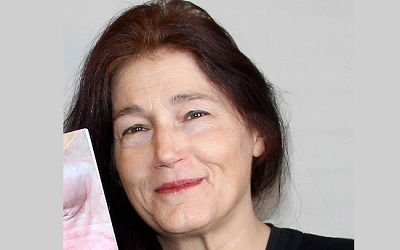
 Laura Rodley, a Pushcart Prize winner, has been nominated for the prize seven times and has also received five Best of the Net nominations. Her recent works include Turn Left at Normal (published by Big Table Publishing Company), Counter Point (published by Prolific Press), and Ribbons and Moths: Poems for Children (published by Kelsay Books). With a talent for capturing the essence of life, Rodley’s writing resonates with readers of all ages. Whether exploring the natural world or delving into human emotions, her words evoke a sense of wonder and connection. https://www.youtube.com/watch?v=PClY8G6HQwk
Guided Tour
By Laura Rodley
Finally. They’d waited three months to attend this guided goat tour. Of course, the unleashed Nubian goats, with their white coats and long beards, just rambled around them with their constantly smiling faces while the guide walked ahead, pointing out wildflowers like maroon trilliums or special rock formations. The idea of it, goat walking!
Then it started raining. “It would rain,” Giselle shook her long blonde braids, and stopped to pull her plastic raingear out of her backpack, as did others that came prepared. There was a list of what to bring. They’d chosen the ambitious long walk, four hours. The four friends had joined ten others.
“A little rain never hurt nobody,” murmured Beatrice, as rain pelted down her wide-brimmed hat, her waterproof backpack and her moisture-wicking clothes, snugly tucking her long black hair further under her hat.
“There she goes, ‘Bea’-titudes, ‘bea’-tituding all over the place. Wait till she says, ‘A little sun never hurt nobody’,” Michelle shook out her plastic wrap, splattering raindrops.
“Somebody must be hungry,” said Rachel. “Too early to stop for lunch. Two goats are loaded for bear with snacks according to the list. It’s 11 o’clock; we’ll stop soon, get out of the rain.”
“Ouch, just whacked my leg on that branch. It really hurts.”
Beatrice knelt down close to the path, picked a couple elliptic-shaped leaves from a plant sporting white flowers that resembled lily of the valley, handed it to Giselle. “Press these shinleaf leaves against your bruise. It’ll stop hurting.”
Grimacing in disbelief, Giselle did so. The pain dissipated. She looked up to thank Beatrice but she was stopped by the shinleaf plants, peering right.
Others watched their feet, avoiding tripping as rivulets formed, slithered on the mountainous forest path, pine needles and leaves lifting and falling in their wake.
An hour later, the guide called, “There’s a hut here, we’ll stop to eat, get out of the rain.”
The crowd cheered. The goats danced as the peoples’ spirits lightened.
Except for Beatrice.
“Where’s Beatrice? She always goes missing,” grumbled Giselle. “Taking off on her own. Again.”
“Can you blame her?” Michelle spluttered rain off her mouth. “She is on her own since her husband and son died in that car crash. She’s never been the same.”
“What do you mean?” someone behind them asked.
“Now you’ve done it, Michelle,” Rhonda said. “Beatrice doesn’t like us to talk about it. You know that. If you must know, her husband went off a hairpin curve over the mountain edge during a thunderstorm seven years ago. Not too far from here. The car burned up; they did too. They salvaged the husband’s remains, said the fire was too hot to salvage the son’s. Rangers looked for months in case he was thrown out but was never found. Everyone gave up. But not Beatrice. But she doesn’t talk about it. Don’t say anything, when you see her, OK?”
“Sure.”
Meanwhile, Beatrice walked towards the lights she’d seen from the path as leaves battered down branches, revealing a narrow pathway. She first thought it was a bear path; maybe the lights were mica set in crystals illuminated by the meager sun. The lights revealed themselves as tiny solar panels, tea-cup-size, highlighting the entrance to a wooden hanging bridge suspended over a several-hundred-foot ravine.
The bridge looked new, sturdy. Amazingly so. Afraid of heights, she held her breath, grabbed the twined rope railings, eased her way across. Kept walking. She heard voices, music from a radio. Turning a corner, she saw an extended village of small wooden huts. Maybe miners mining gold up here in the mountaintops. Someone was hammering a piece of steel, straightening out a dent.
Two people looked up, noticed her, an older man, grizzled white hair, hatless. The other was a young man, about five foot three with shoulder length black hair, and blue eyes. He looked at her.
“I got turned about, lost in the rain,” explained Beatrice.
“A little rain never hurt nobody,” the young man wiped his hands on a chamois cloth, walked towards her.
“Raymond? Is that you? You’re all grown up.”
“Hang on a minute. This here’s Harry,” protested the grizzled-haired man as a woman ventured from the hut and two others appeared.
“It’s Raymond, my son. He was lost in a terrible car accident. Presumed dead. I never believed it.”
“We found him in the woods, didn’t know who he was. He couldn’t talk.”
“Why didn’t you contact someone, the authorities?”
“We were on our way, but he was so happy here. So, he stayed.”
“At age eight, he decided?” Beatrice struggled to keep her voice steady, not to spook anyone as the people stared at her. “Does he have a birthmark on his right arm shaped like a hawk?”
The man looked at Raymond as he raised his arm, revealed the birthmark.
“Mom, is it really you?”
Beatrice held out her arms.
Raymond rushed over, knocked off her hat, revealing her hair black and long as his. As Beatrice and Raymond embraced, loud clattering spluttered behind them as goats and people appeared.
“Here you are. We had to cross that nasty creaking bridge. The goats wouldn’t stay put, insisted on leading the way.” Michelle exclaimed.
“I found Raymond.”
“I never,” Michelle covered her mouth with her hand.
 The Galway Review