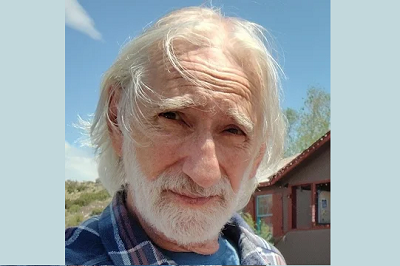
 Alan Abrams, a retired builder, dibbles in poetry, and dabbles in long and short fiction. His stories and poems (including a Pushcart nomination) have been widely published in journals and anthologies, including the Innisfree Poetry Journal, The Raven’s Perch, The Rat’s Ass Review, The Galway Review, and many others. Abrams is also the editor of Sligo Creek Publishing.
Beneath the Surface
I’ve rarely seen another soul,
the many times I’ve visited,
to watch the geese arrive, depart,
with some purpose all their own.
Mine? To monitor the ripples
inscribed by indecisive winds,
mark where they are broken,
by muskrat, turtle, splash
of leaping carp.
Not a tinker’s damn do they give
for their nosy witness,
nor for the noisy world beyond.
Here, perhaps a lesson—
should I care to take it.
Gravity
Buzzards amuse me, so ugly, at least
to my eye, it’s a wonder they reproduce.
Yet these creatures that feed on death
are plentifully alive. Sometimes,
scads of them aloft.
It’s how they soar that really gets me,
the way they rock on the axis of their flight,
wings tipping up and down, like the arms of
a drunk struggling to walk a sidewalk seam
before a suspicious cop.
All this, in effortless defiance of gravity,
that ever-present, omnipotent force
that turns our cheeks to jowls, sags
our breasts and buttocks, and at
time’s end, draws us down into the earth.
Yes, gaze at them and marvel—there’s likely one
in view this very moment. So I beg you—
fling this book into the air!—let its fluttering pages
be the feathers that liberate these earthbound words
from gravity’s dominion.
EPA Rescinds Landmark Finding
Lots of people seem to hate the Earth;
maybe they hate their own mothers as well.
But even though the end seems near,
I still recycle scraps of aluminum foil,
go around turning out lights, upsetting
my wife when I reset the thermostat.
But I, too, took more than I needed—
acres of forest for the houses I built,
for the paper that landed at my door each day;
that deer I shot and had to leave behind to rot,
when my buddy refused to load it in his truck,
it being a doe, and out of season at that—
some atonement can last a lifetime.
And maybe I could have loved my mother better—
she was hard on me growing up,
although that’s what I needed, and likely, more.
At least I was kind to her when she grew old.
That’s why I unplug the modem before going to bed,
don’t linger in the shower, drive a car that’s good on gas—
understanding all the while—you can never even the score.
Upon an Upturned Bench at Kenilworth Marsh
I said to the almond tree, “Sister, speak to me of God
And the almond tree blossomed.”
—Nikos Kazantzakis, Report to Greco
It’s beastly hot for man if not for beast,
where I teeter on an upturned bench
(its seat is now its back, its back, the seat)
and gaze across the swollen marsh, as
an egret stalks the shallows—
strikes—shakes—swallows.
Swifts skim the mirror surface
in pursuit of insects, unseen.
Omen clouds conglomerate,
distant thunder mumbles.
Drizzle turns the pond to lace,
and the temperature tumbles
for beast and man alike. In no rush
am I to quit my precarious perch,
upon this tottering upturned pew,
in this mizzly sylvan church.
The setting is just inside the District Line, near the Aquatic Gardens
(Previously published in The Braided Way)
“Sometimes, the Stranger is Strangely Dear”
—from “Slogan 7,” in LOCOMOTIVE CATHEDRAL,
by Brandel France de Bravo
A stroll under towering poplars,
sprawling beech, the night cold, clear,
mischievous stars playing hide and peek
through the leafless canopy. Full moon:
an oncoming Harley headlamp.
Back home, Miles Davis braying
on the CD, gummies kicking in.
I pick up Brandel France’s latest book.
She barges in like you’ve left the door ajar
and she just happened to be passing by,
you know, like some old friend,
maybe someone who didn’t work out,
but you’re still glad to hear from her anyway.
Hair on fire, she lights into it, Dean Moriarity
yackity-yacking to Sal Paradise, yah!
dubbledyclutch, dubbledyclutch, all the way
across the Rockies without tapping the brakes.
Then—you come to that one about Ahmaud Arbery.
You’ve got to brace yourself with feet up on the dash,
riding shotgun on those helical strands of verse, rising,
weaving, coiling—like that two-lane that snakes up
into the heart of the Sangre de Cristos,
and on the way back down, taking you someplace
you’ve never been before.
That’s when Miles eases back in, stealthy cat,
lungs, lips, tongue; three manic fingers translating
the sounds of birds and beasts into the music
of a non-earthly realm—
trascendente—
like the poems of Brandel de Bravo.
 The Galway Review
Damn fine dibbles there, Alan. Deadly!