Higgins’s Poems: A Poetics of Reflection, Memory, and Civic Ethics
Reviewed by Dr Armand Kodra
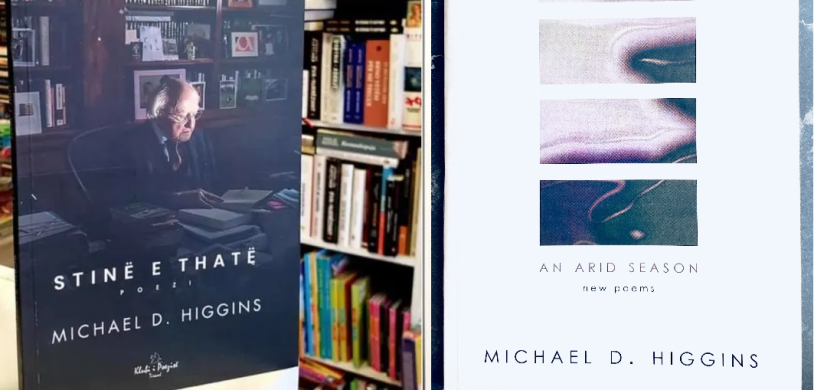
I was utterly captivated when Michael D. Higgins’s poetry collection Stinë e Thatë—the Albanian translation of An Arid Season by Ndrek Gjini—landed in my hands. I devoured it in a single sitting, enchanted by its depth. My curiosity piqued, I tracked down the English original, purchased it, and reread the entire book. The pleasure was identical: profound, resonant, and rewarding. This is a triumph of poetry and translation alike, one that compelled me to share my thoughts.
Among recent poetic bridges from Irish literature to Albanian readers, Stinë e Thatë shines as a pinnacle. It introduces one of modern Ireland’s most unique voices while forging lasting cultural ties between our nations, rooted in a poetics of introspection, remembrance, and communal ethics.
Discovering the Poet-President
Michael D. Higgins embodies Irish culture’s richness: scholar, activist, wordsmith, and President, infusing his verse with undeniable moral gravity. Collections like The Betrayal, The Season of Fire, and An Arid Season (2004) probe violence’s scars, flickers of hope, and humanity’s resilient ascent through history’s tempests.
In Stinë e Thatë, Higgins reveals a keenly social sensibility, rendering history vivid through the lives of the overlooked—ordinary folk battered by poverty, conflict, and inequity. His lens fixates on dignity’s quiet claim for the silenced, echoing his sociologist roots and human rights advocacy.
His style masterfully blends lyrical grace with philosophical probe. Verses sprout from everyday images—a barren tree, a restless night, a sterile hospital ward, a humble shack—evolving into contemplations on time’s erosion, power’s distortions, and memory’s indelible etchings. Archetypes like parched darkness, cosmic dust, turbulent seas, fleeting light, and lurking shadows symbolise our navigation between aspiration and despair, justice’s pursuit and solitude’s sting.
Themes and Vivid Imagery in Stinë e Thatë
The “arid season” motif pulses beyond climate into existential and ethical barrenness: eras when language falters, bonds fray, and souls confront moral desolation. Time unfolds as a suffocating void, starved of words “to kindle the senses’ fire,” heralding a profound rupture in empathy and expression.
“Pluhur yjor” (“Stardust”) stands out, opening cosmically: “We are stardust, forged from vapours and particles.” It traverses stellar vastness to earthly frailty—dashed dreams, betrayed vows—imparting a transcendent rumination on origins and destiny.
Recurring darkness looms “dry” and ominous, lightless; silence imposes a near-political hush, beyond mere introspection. These evoke the erased: lonely patients, barren couples, poverty’s stoic sufferers eyed warily by society. Poetry thus resurrects memory, enacting symbolic restitution.
Uniquely, Higgins fuses personal intimacies—love’s bloom and blight, isolation’s ache—with societal chronicles: upheavals, movements, shared duties. No sloganeering here; politics emerges organically as coexistence’s ethic, via poignant vignettes of real fates.
Ndrek Gjini’s Translation Excellence
Ndrek Gjini—Albanian poet, writer, journalist, and translator, steeped in linguistics and thriving in Ireland since 2002—is perfectly suited. As The Galway Review‘s managing editor, his literary immersion ensures authenticity.
This rendition elevates cultural exchange, stocking Albanian shelves with a president’s verse. Higgins lauded it in correspondence: “absolutely stunning,” thrilled by its fresh reach. Precision meets poetic fidelity.
Gjini balances erudite terms with stark imagery, mirroring Higgins’s contemplative cadence in Albanian. In “Pluhur yjor,” “dry darkness,” or “airless time,” restraint amplifies meaning—no frippery, just potent semantics. Eschewing ponderous idioms, he aligns with contemporary verse, appealing to novices and connoisseurs.
His effort crowns broader bridging: writings, renditions, Galway engagements. Stinë e Thatë embodies dialogue—an Irish leader-poet voicing universals in Albanian, via an insider’s artful conduit.
A Timeless Cultural Triumph
Stinë e Thatë, via Gjini, proves poetry’s borderless power, converging traditions on dignity, recall, and hope. It grants Albanians intimate access to a nation-builder’s muse, affirming our translation prowess against global peers.
This slim volume lingers, urging rereads. For poetry lovers, it’s essential; for cultural explorers, revelatory. Higgins and Gjini remind us: true art heals divides, honours the forgotten, and reignites the human spark.
 The Galway Review