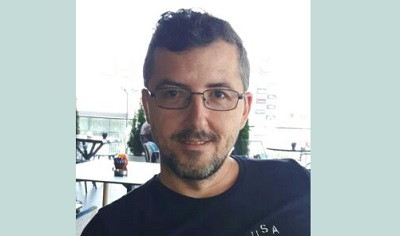
 Daim Miftari is a poet and literary translator from North Macedonia. He was born in Gostivar in 1979. He obtained a Master of Science in Literary Studies at “Blaže Koneski” University of Skopje. He has published seven poetry collections as well as literary studies, and has translated several Macedonian poets into the Albanian language, published in the literary press.
He worked as a journalist covering cultural issues at the Fakti newspaper (2007–2009), as a professor of Albanian language at the high school “Zdravko Cvetkovski” in Skopje (2007–2009), as a translator from Macedonian to Albanian and vice versa at the daily newspaper Koha e Re (2010–2018), and from 2018 onwards, he has worked at the Ministry of Culture of North Macedonia, Books Section.
He lives in Skopje.
How did you become a memory!
Useless to ask you, how did you enter in,
when I locked the door and turned off the light,
ready to sleep. You can’t prevent yourself
from coming. I can’t prevent myself from seeing you.
Pain
It starts in my apartment,
any time it reminds me.
Carelessly,
it walks past the passersby,
to my neighbours, my stairs,
and climbs up.
When it happens
that I am busy doing something
or looking for a book
on the shelves
which gets lost from my sight,
it waits for me patiently,
standing behind the door until I open it.
It sits by the table
and eats from my plate,
filling its mouth
as if it is starving.
It lies in the bed
and kindly lures me
like a childhood memory.
When it happens
that I am not at home,
it sits on a bench
in front of my entrance
and waits
in summer and winter,
on a rainy, snowy, or sunny day.
It comes running to me,
like the longing look of children
whom I left sleeping
in the morning.
And when I go back home,
they grab my food bag,
taking their favorite things.
It notices me easily
in the daylight or in the darkness,
when I am alone or in the midst of people.
Sunday
On the balcony,
the overflowing ashtray
smells of burned thoughts
from last night.
The children have spread out dolls
throughout the room.
I see them playing
and I am moved,
remembering my youngest sister.
Outside, it’s good weather.
Beyond the window glass,
through the green linden boughs,
the birds
wander joyfully.
My wife reminds me
of unfinished housework,
buying food.
—We should paint the apartment—
she says.
—The walls are bleached,
the ceiling as well,
mold has dressed the rooms.
The children remind me
of what I promised them last night.
I think about how much money I have in my pocket.
Someone is ringing the doorbell.
The food gets cold on the table.
Winter in my veins
My mother is looking for something
all the time,
as if she has really lost something,
looking down
around the couch.
Death is hanging around,
looking at the wrinkles
on her forehead,
caressing her grey hairs
one by one.
The highlands’ winter
descends into my veins
as if it means
it’s the end of the road.
Lament for my grandfather
My grandpa gave his last breath.
He became tears
in my eyes.
He took forever
all his tales,
when I used to chase him
as a child,
like a lamb.
When I saw him for the last time,
death, like a train horn,
was howling
at the station.
I wept,
he became tears in my eyes.
Now I meet him
only in my dreams.
Sometimes, he comes to me
like someone touching my arm,
Hi, my grandpa,
to greet him.
Poetry
I didn’t know exactly
what you were
and what you wanted from me,
when you extended your hand to me
one day,
like someone who lost his road
in an unknown,
distant area.
Then I feared you,
when you looked at the pain
in my eyes
without being scared,
like a rebel child
who argues with
an authoritarian father.
I don’t know exactly
what happened
when for the first time
you walked towards me.
My hands were trembling,
I was still a minor.
But I strongly felt
your heart beating.
You gave me your hand,
waiting patiently, stubborn,
like pain.
And when I couldn’t write you
as you would like me to,
you said, “Throw me in the garbage,”
showing no regret.
Translated by: Kujtim Morina
 The Galway Review