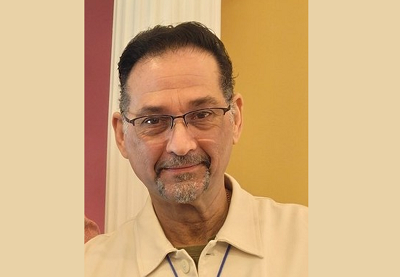
 José M. Tirado, Ed.D., is a Puerto Rican poet, Shin Buddhist priest, and political writer living in Hafnarfjörður, Iceland. His work engages questions of labor, migration, spiritual practice, and social justice through a working-class Latino lens. Drawing from urban life, transnational experience, and Buddhist ethical inquiry, his poetry explores gentrification, displacement, grief, and dignity while insisting on compassion rooted in material reality. His writing has appeared in The Galway Review, CounterPunch, Buddhistdoor Global, Dissident Voice, La Respuesta, and Lion’s Roar. He teaches at the University of Iceland.
The Street Now Taken
Two cracked windows called from the old school
Where the smell of lemon cleaner once rose wildly then
Washed down the city streets to the criss-crossed drains
After the cooling rains in summer.
Now, a stink of damp fresh tar floats above
The bonded gum wads along the old, closed off
Subway steps where the dying sleep to
Ward off the future.
They´ve built a tower there, office tight and blue above,
Parking garage gate ready below for the shiny cars to chill.
Fences behind the alley remembered
The old games there, stickball names were made and given
As boys planned their first million
In smoke-drenched hazes next to sonorous trashcans.
Up, up high they´d look and see the End
Would be the same as when it started (for them) –
Where men in yellow hats steer muscled arms on yellow cranes to glide
Straight beams to fit every day a new link in a new armored city.
Even the pigeons felt it.
Faded flapping billboard ads whipped along wooden blockades
And somewhere else a radio spilled it´s happy innards
As silver traffic moved towards finance-now there, now here;
Now everywhere pushing life out, sucking the lifeless in.
Some streets filled daily these days with only the crack heads
And the light pastry smells from the bakery down the avenue
And the Greek sandwich shop long stands quiet:
Panos and brothers back to Thessaloniki for good.
But back then, so many remembered when, across from fruit stands
The tailor made dresses that were part of the people´s scene, none refused for funds,
(Who had money?) the tailor and his wife walking humbly every night
Before the stone red brick faced building they called home.
And the parents always stopped to greet the families on the stoops whose shoulders
Never lifted or eyes wavered from the little girls in white
Born just over there, just a few short years ago when hop-scotch squares
Were stomped on and jump ropes went about their brisk business.
Checker champions greased their hair at night
To dance rumba for the girls whose stakes in the street were higher.
Few ladies took their eyes away from their men long enough
To see the whispers of jobs elsewhere coldly etch a sketch the men´s faces permanently.
Life on this street was filled on weekends with the color crazy sounds of
A dozen cultures competing to float the dreams of the
Hardest dreamers towards the shore where, hopefully it would stream down to Miami,
Or LA even, for some sun, but Brooklyn would do for most. It was home.
And the Church was packed with the five sad Poles.
And the Temple murmured down the street.
Back then the Moses of Montana Street walked prophetically on the white lines in the road
Keeping his shopping cart evenly cut on the north side and the south side
While his beard and flaming eyes saw past, present and future in a guttural flash,
While the Koreans got the bar-b-q fires ready for the weekend.
There the grates held the heat as the girls stoked boys´ fire near alley entrances
The sea of heads bobbed with triple the people registered to hear
The concerts the lot held: the salsa, the plena, later the drums of Ghana and Nigeria,
Brought up from Jersey to join near the chess club in front of the old bodega.
And the Dominican dancers moved like lightning in July
And the hoodie cats tore buttons off their coats.
No musicals would now be filmed to showcase some dancers´ toughness,
No waving sea of bobbing heads would laugh in front of the
Cold aluminum blue box where suits will make flat bucks in front of flat screens
Counting the lofts imaginable for the quick bargainer who makes it in, quick.
Eventually the Evangelico church doors would close
And the Poles would count on two fingers the sad ladies
Whose sons travelled away a long, long time ago.
The Dominicans would move to Orlando, the Boricua flag wavers going with them.
The bomberos won´t be called to cool kids down with hydrant sprays, anymore,
And street signs would get new leases unlike those whose lives once glowed on this street,
Now taken, waiting for jobs at the Starbucks in the air-conditioned lobby of the office building
Where the atrium lets in the sun above, lighting the security guarded fountain in the center.
Where nobody can drink the water.
And no one dips their toes.
Biology Lesson
It began in the bedroom,
Right there, in medias res,
Simultaneous with the stirrings
A wretched observation that comes, at the wrong moment,
From afar:
This meeting is nothing more than a
Bubbling, bumbling yearning of
The universe to see itself biologically,
Crude, ridiculous in its jerky nervousness.
Biology doesn´t lie.
They break for lunch.
The big picture secured, he sits smiling afterwards,
Though inside, a gnawing wonder, ancient yet still very raw
Disturbs:
“Just for this?”
The picture of the lilacs in the hall properly faces north,
Above the couch in the white living room, three more defend the scene,
& in the bathroom, the toilet paper sheets roll open on the wall side,
As it should be; the cat has his tray securely in the kitchen corner as well.
History records many such examples.
There was a slithering electricity at one time,
An old serpent-blessed magic which innocently reflected the vibrant light
In many of the rooms, daily.
There was.
The lawn mower struggled with the tall grass
On the Sunday it hit him. Nobody else saw anything.
Atop the backyard wall, Diego spotted birds with murderous calculation-
Before noon, one of the smaller ones would be gifted to her.
He envied that simplicity, that sincerity.
Biological. This was not so much the end of a line, he reflected,
More a crack through which some new, less innocent light burned the soul,
Turning the placid order of the finite
Into an inexpressible, almost ghastly Infinite.
Something had changed. Across town, the car dealership
Made a brisk run this weekend.
On the computer screen, recorded sales
Filled the program until coffee time.
The air also shimmied with dust sparkles so that
Outside, the white shirts of the brown customers appeared angelic.
Only a few hours more, he thought, just before
The crack opened again, revealing this time, some inner container
He once built in the dark, before experience collected.
A realization off to one side maybe, but still there,
Unshaken by being glimpsed.
Dinner was livelier with Santa Rita and fresh ceviche.
There were even fresh smiles since Peru was where the best
Ceviche they´d had was prepared. On a bed of wild rice in Lima
They´d planned biology then – at least, that´s the way he now remembered it.
In biology it began, in biology it will end – he shook this
Last one off for a stiffer glass of Sherry and a sliced tomato.
“We have much to be grateful for” she celebrated, almost cooing.
He blinked, blinded to panic but
The crack stayed completely hidden from her, for now, and
He was most grateful for that,
So, he smiled. Grandma´s dishes cleaned, the table made,
Even the cat Diego looked sated, neatly biological.
Stepping barefoot outside, the cool moist, freshly cut grass
Tickled but they watched the stars together with a glass each
And contemplated different worlds:
One demanding grateful acknowledgment,
The other, holding an ominous cracked sphere near the heart,
Pregnant to bursting with a light too
Lucent to bear, too eager to be born,
Too biological to ignore.
Some Simple Pleasures At Work
A wind whistles through baby frames of homesites
Laughing like song.
The morning roach coach coffee rush reaches
Calloused hands as scratchy music scuffs up the air.
The bricks, the paint, the dust breeze,
Still, at twelve o’clock I sleep in the sun.
The Welcoming Wind
At dusk, his steps are rough,
with a dry grace of
flat-footed tenderness;
the spring is gone,
& forward is the march.
In the grinning breeze he stops,
faces the pressure, feels it, leans in,
pressing into the airy opposition:
the force, that strength of Time
which faces him
along the winding red walkway bricks
of the harbor.
In time, some bench may call &,
sitting down, he will face the sea, watching
the terns & spins of the gulls
as they follow the ships
to feast on ready meals,
tossed by the time-tossed,
up to
the welcoming wind.
 The Galway Review