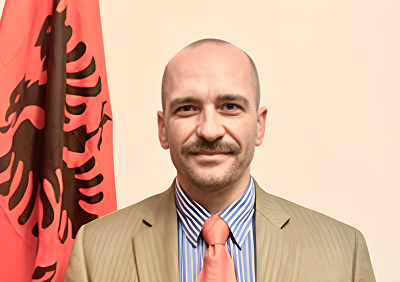
 Uran Ferizi, PhD, is the Ambassador Extraordinary and Plenipotentiary of Albania to the United Kingdom and non-resident Ambassador to Ireland, as well as the Permanent Representative to the International Maritime Organisation. Dr. Ferizi’s early career was in finance, working on feasibility studies for major infrastructure projects like London Heathrow and Singapore airports, and later in investment banking at Bear Stearns in London, specializing in fixed-income structured products. Academically, he studied Mathematics at Oxford University and earned a PhD in Neuroscience at University College London, developing mathematical models for brain imaging with collaborations including MIT-Harvard and UK hospitals. His postdoctoral research at New York University and Stanford focused on arthritis, osteoporosis, Parkinson’s disease, and addiction biomarkers. Born in Albania, Dr. Ferizi studied and worked in the UK and USA for over 25 years. He is dedicated to advancing Albania’s cultural, educational, and trade relations with the UK and Ireland.
A Morning Behind the Iron Doors
– At His Majesty’s Prison, Fosse Way, Leicester
By Uran Ferizi, PhD
I waited fifteen months until they finally let me enter the kingdom of locks and keys. Twelve Albanian inmates were waiting to meet me.
On the other side, my colleague Andi and I arrived at 9am. Belts off, shoes off, pockets turned inside out. Mobile phone put away as if it were a machine gun.
Door, clank. Another door, clank. More security doors appear into the distance. One officer, a stickler for protocol, stops me: “Where do you think you’re going in a hoodie?”
I protest that “outside it’s minus one degree … and besides, no one told me about the hoodie”. I mention the email they’d sent. I insist I read it very carefully.
He has zero sympathy. “You’re the first ambassador who’s ever come; no person from any embassy has ever come dressed like this,” he says. “Next time we’ll put in the email: no colander on the head either.”
I sense what I should have understood sooner: this is a place where rules must be obeyed, as well as guardians not outwitted. Especially if one wishes to pass through any gates … and into the large meeting room. I get through.
In less than two seconds they appeared. Twelve men who greeted me as if I were their cousin arriving at their wedding. Most barely past twenty, two in their forties. (In another corner, two very friendly Polish consuls are talking to three of their lot; while the cheerful German consul looks stood up.)
The Albanians take chairs from around the room, and we sit in a circle. No need to invite anyone over. They stick together; they know the drill. Two are the most talkative, but still let others take their turn. I move frequently through chairs so nobody feels distant.
Wasting no time on diplomatic niceties, I ask them “what did you do?”, drawing a zig-zag line in the air with my finger to mean it at all of them.
Half said cannabis. Two had driven away from the police. Three for cocaine dealing. I asked one of the dealers, mischievously, “Did you at least use what you sold?”. “Never in my life. Not even a cigarette.” The other two shrugged: “Cigarettes sometimes, yes. Alcohol, never. Hard drugs, no. Noooo.”
We may speak of inmates as if they belong to another species. Some blame the poison in the blood, others the society. I looked into those twelve pairs of eyes and saw humans. Young men who had taken a wrong turn in the roads I know too well.
They were sharp and funny, merciless with themselves and with the world. After two hours of stories and black humour, I told them I had to leave. The elder said “will you come again?”. I smiled, lost for words. Two others repeated it. That question, and the warm handshakes, just before I headed for the exit gate, is the highest (and most worthy) praise I have received in this job.
A nation is not only its flag and its anthem. It is also twelve young men locked far from home, who still smile when luck (and the world!) is tough on them.
 The Galway Review