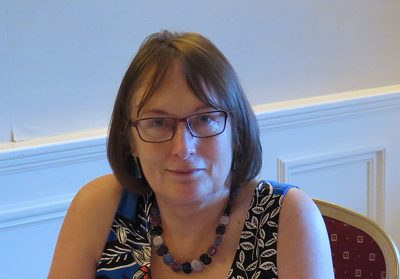
 Phil Carrick was born and raised in Ireland and educated at both UCD and Trinity College Dublin Writing.ie published three of Phil’s memoirs between 2022 and 2025 for their ‘Mining Memories’ archive. The Galway Review has published her fiction from 2020 through to 2024. Fish Publications, Cork, long listed a memoir in 2019 and a short story in 2020. Three of Phil’s poems were published in the Poetry Collection “2020 Visions” produced by the Ballymun Library Writers Group, Dublin. Currently, she is working on a book of short stories and her first novel. Phil is a member of the Rathmines Writer’s Group.
The Christmas Tree
By Phil Carrick
My father felt it would be a sin to pay good money for a Christmas tree when there were hundreds of them on our doorstep. In the late 1960s, my family rented an old Tudor-style farmhouse in rural Ireland. Lush green fields surrounded the house; it was a functioning farm with livestock run by our landlord. Pine woods shielded the house from a long country road linking two local towns, and to access our front door, one had to travel up an avenue half a mile in length. The woods were cultivated with tall pine trees that reached heights of fifty feet or more. Shorter varieties of spruce and pine trees grew in large sections across the road from our front gate, and these were harvested yearly at Christmas. Naturally, we children sympathised with Dad’s opinion and were excited to assist in the procurement of a tree. My mother, aware that a plan was being hatched, chose to ignore it in the interest of protecting the younger ones from corruption.
It was the year of my eleventh birthday, and Dad invited me to join my older brothers, Padraig and Liam, in collecting the tree. A few nights before Christmas, he sent us to the garden shed after dark to do some tidying. Mam took the four younger ones upstairs to get ready for bed. A strong scent of tools quickly replaced the fresh baking smells of the kitchen. If these scents, oils, greases, paints, timbers, dampness, grit, and dust had a colour, I imagine it would be dark brown or black. We waited for about an hour and occupied ourselves, experimenting with various tools, chatting, and laughing. Padraig took down an axe from the nail hook and said he was the only one allowed to use it. Liam boasted that last year, he used the saw on a tree trunk. They told me that last year, when they reached the woods, they quietly snuck down the grassy pathway separating the rows of trees and picked a tree with a good shape. It must be a few rows in from the edge.
“Why?” I asked.
“If you cut one down from the edge row, it would be too obvious, and the woodcutter will spot it easily,” said Padraig. Liam added:
“After we had picked a tree, Dad hacked off the lower branches. We sawed through the trunk, keeping close to the ground. Then we use the axe to hack off the last bit.
They hid the loose bits of timber and bark under grass and twigs in an unused area of scrub. In case the woodcutter might notice a fresh cut, the boys gathered soil and dead leaves to darken the surface.
I was intrigued by this information, including the planning, the various tools, the stages involved in cutting down the tree, and hiding the evidence. Also, the secrecy, not letting Mam know precisely what we were up to, going out in the dark of night and sneaking about. Padraig became energetic, making swinging moves with the axe into the air, and Liam pretended he was sawing the workbench in two.
Outside, a thick layer of cloud hid the stars, adding to the darkness. When Dad arrived, he handed me the large flash lamp to take to the car. He said:
“You take the front seat. Your job is to be our lookout.”
I was delighted with my role and headed for the car. I heard Padraig being told off for swinging the hatchet, and Liam was instructed to carry the saw safely. The boys folded down the back seats in the car to create space and sat in the back nursing their respective tools. Once inside the car, Dad seemed in high spirits and outlined the plan.
“The trick with this job is to get it done quickly, but there are some precautions to take first. I will drive towards the crossroads heading towards Kilcullen town. Keep your eyes peeled. Check if anyone is walking on the road, anyone on a bicycle and any cars coming.”
“Will we check the protestant church at the crossroads?” asks Padraig.
“Yes! Take a good look around the church and check for any light showing from inside, or cars parked outside. I expect everyone will be gone for the night at this time, but it is wiser to check.”
“Why the church?” I ask.
Liam replied:
“If there is a service, the people going home will drive down our road past the pine plantation. We don’t want to be seen.”
Dad started up the engine and headed down our avenue. I jumped out to open the iron gates and left them open for our return trip. We turned right towards the crossroads. I was trying to look through the darkness, searching the hedges and shadows, looking deep into the fields and over the lower ditches, checking for movement. There seemed to be no person or animal about. No farm animals were visible because the farmers had taken them indoors to protect them from the cold. Dad interrupted my concentration and told Liam to keep a lookout from the rear of the car and let him know if a vehicle was approaching. This was great fun. I looked at my surroundings more closely than ever before. Dad drove through the crossroads and a short distance beyond and then turned around. We checked the church carefully, but there was no light coming from the arched windows, and no cars were parked outside.
“This is good! We haven’t seen a sinner since we left our gate.” Dad lowered his voice a little as if someone might be eavesdropping and continued:
“I will drive back past our gate now, and down as far as the shop. Keep a lookout and don’t miss anything.”
The shop was located at the junction of our road with the main road going to Naas, a larger town about seven miles away. The shop would be closed at this late hour; it was well past eleven o’clock. There was only one house down from ours, and that was the O’Malley’s place. A small farm holding with the family residence fronting onto the roadside. Dad said to look around the house for any signs of activity, such as a person carrying coal, retrieving something from a car, taking out a bicycle, or putting up Christmas lights. He was thinking of everything, but when we passed the house, it seemed as if everyone was asleep in bed. The only light I noticed came from the fanlight above the front door. Our car slowed down a little, and O’Malley’s dog must have detected something because he let out a loud, sharp bark, which made me jump in fright. Dad laughed loudly, and the boys joined in, so he told me to take it easy. When we got to the shop, Dad drove into their yard and turned the car. Two cars passed on the main road to Naas, but they did not go our way.
My excitement rose even higher when Dad said:
“This is it now. I will drive back along the road and stop at the plantation gate.”
I was distracted on the way back and forgot to check for people and bikes until my father said:
“Don’t forget to look about.”
“No! No! I lied”
“I will pull in a little onto the grass margin, but I must leave the car lights on low; it would be too dangerous to turn them off. Fionnuala, you stay in your seat and open your window. We will climb over the gate with the tools and move a bit away from the inside of the gate. Keep watching the road for lights, car lights, bicycle lamps, and people walking with flashlights. Look both front and back. If anything shows, do not get out of the car, just shout out to us. We won’t be far from the gate, OK.”
“OK! I said.”
There were lots of questions falling over themselves in my head, like what if the lights come too close before I see them; what if it’s a man on a bike, he will hear me calling out; what if a car slows down and stops. None of my queries got as far as my mouth. I passed the flashlight to Dad as he got out of the car. Lifting the hatchback, Dad waited for the boys to scramble out. They followed along behind him in silence. I opened my window; the cold air swept in and cut into my cheeks; I wished I had grabbed my woollen cap off the coat rail. The scent of pine trees mingled with the damp aroma of rotting leaves and earth. Dad climbed over the wooden gate and helped the boys over. As they wandered into the half-darkness, they became blobs of black. I could hear Dad giving instructions:
“Don’t drop that.”
“Hold it higher.”
“Mind your step.”
“For fuck’s sake!”
“Give me the light.”
There was no answer from the boys, but I didn’t expect any. Seconds passed, and I realised that I had forgotten to look up and down the road. I looked along the roadway, the hedges, and the skyline, listening with intent, and then repeated the process, looking out the rear window of the car. Back to the front again and:
“There’s a light. No, it is not. Oh, God, it is.” I am talking to myself.
My heart was pounding, and I imagined there was no use in praying to God. In this situation, the less He knew, the better.
The decision to panic took a few seconds.
“Dad, there is a light”, I shouted, but my voice squeaked like a mouse.
“Dad, there is a car coming,” I shouted louder.
“From the front…” I roared.
“Dad”
I knew my call was too loud, but how do you shout quietly? I saw Dad’s shape in the dark now. He was trying to shout in a whisper, and it came out in a gravelly sound.
“Shush! Close the window and stay there. It will pass. Do not get out of the car.”
OK, Dad, I trust you. I wound the window up and watched the lights, like two distinct white orbs growing larger as they drew closer. I have heard people say that their hearts stopped with fright, but mine was hopping about like a mad frog in my chest. The car slowed as it approached and came to a stop opposite our getaway vehicle. I could see it clearly now, and it was not an ordinary car but the squad car from Kilcullen. I wished we had rehearsed this scenario. I wanted to cry or cry out, ‘Dad, now what do I do?’ but I did nothing.
The guard on the passenger side of the squad car stood out into the cold night air. He settled his hard hat in position and walked, as if he had all the time in the world, towards me. He leaned down and tapped on the driver’s window with the back of his hand. I felt time was slowing down. I shuffled over to the driver’s seat and wound down the window.
“Good night, Miss,” said he.
I could not speak.
“Are you on your own?”
This prompted me to respond, but only single words would come.
“No!”
“Who is with you?”
“Dad”
“Where is he?”
“I don’t know.”
My gran’s expression, ‘don’t know, never told a lie,’ Came into my head.
“Don’t know!” the guard repeated.
God! This could go on forever. Then the tricky question:
“What’s your name?
Oh God, can I tell him that? Can I not tell him?
Then I heard my father’s voice:
“Goodnight, Sergeant! Is everything alright?”
My father stepped down from the wooden gate and was busy fumbling with the waistband of his trousers. Then he shuffled his coat about. There was no sign of the boys.
“We thought the girl was all alone,” said the sergeant.
“Ah, no, I’m here. Got caught short, you know how it is.”
My mind did not take in what my father was on about just then, but afterwards, I thought he was brilliant. Dad walked to the driver’s side of our car. I felt relieved that my questioning was over and delighted that I had not given my name. The guard mentioned the cold, dark night and that frost was expected. He said, “Good night,” and waved to me as he turned and went back to the squad car. Dad sat in the car and said in a lowered tone:
“Don’t look around too much. We don’t want to raise suspicion. I am going to drive off now as if heading home.”
Dad was looking straight ahead out through the windscreen. Then he started the engine, and the car slowly took off. About a minute passed:
“I want you to look around now and tell me if they have driven off from the gate.”
“They are pulling out now.”
“Are they heading this way?”
“No, the car is heading towards the Naas Road, like we did earlier.”
“Where are Padraig and Liam?” I asked.
“I told them to keep hidden.”
I felt sorry for the boys and imagined they must be petrified; I was safe in the car. Dad drove as far as our own gate and parked, leaving the back half of the vehicle still on the road. I was worried he might go up to the house. All hell would break loose if Mam knew the boys were hiding in the woods. I had forgotten about the Christmas tree and said:
“You are not going up to the house!”
“I’m not crazy. Your Ma would kill me. Look back down that road and tell me if the guards are gone out of sight.”
I scrambled into the back of the car to get a better view. I could see no lights at all. They were gone.
“Right, we’ll head back and get the lads. We must be quick.”
“And the Tree?”
“That too.”
The excitement was wearing thin for me now. I just wanted the boys to be back inside the car, with the Christmas tree. This time, Dad pulled right into the gate of the pine plantation, shining the lights down the narrow grass pathway that ran beside the trees. He got out and called to Padraig and Liam. They came running. I heard Padraig say:
“Will we bring the tree?”
“Of course! Hurry up!”
They turned back a few yards and appeared again, dragging the tree. Dad got over the gate to help them and told me to open the hatch quick. Within minutes, all three of them were shoving the tree into the car. A swoosh of bitterly cold air swept in as if it were angry with us. The boys jumped into the back quickly, and Dad closed the door over the tree trunk. A refreshing smell of pine filled the car, masking the usual dry cigarette smoke. Padraig and Liam were shivering so much that I could hear their teeth chattering. Dad started the engine and drove at high speed to our gateway. He went straight through and up the avenue to the house, not stopping to close the gate.
“Let’s get this inside now as quickly and quietly as possible. Not a word to your Ma about the guards, right!”
“Right,” we chorused.
For the first time ever, my father made us drinking chocolate. He was very clumsy with the boiling kettle but managed to open the tin of Christmas biscuits swiftly enough. Thankfully, Mam had fallen asleep upstairs with the younger ones; someone always had to lie down with the baby to get her to sleep. After heating up by the fire with hot drinks and biscuits, we laughed about the adventure. The warmth of the kitchen and the sweet, Christmassy scents of chocolate and biscuits helped us feel at home. We had to keep our voices low, and Padraig told us how Liam got scared and wanted to run home along the road. Liam belted Padraig’s arm for providing this information, but Dad calmed them by saying that we all had done a great job and were very brave. We went to bed happy that night. For all the following Christmases, we purchased a tree through the local shop.
 The Galway Review