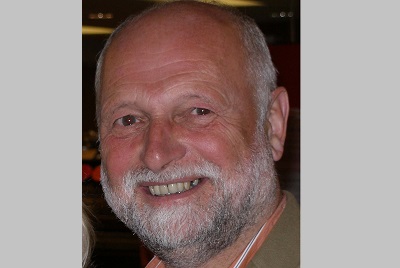
Terry Gifford’s poems appeared in The Galway Review in July 2019 and 2020. He is Visiting Research Fellow in Environmental Humanities at Bath Spa University, UK, and Profesor Honorifico at the Universidad de Alicante, Spain. His eighth collection of poetry is A Feast of Fools (2018). Author/editor of seven books on Ted Hughes, he also wrote D. H. Lawrence, Ecofeminism and Nature (2023), Pastoral (2020), Green Voices (2011) and Reconnecting with John Muir (2006). He is the editor of Reading D. H. Lawrence in the Anthropocene (2025). See http://www.terrygifford.co.uk.
Love Song
Its length betrays
its desperation. It is loud
and brash, but melodious.
It is a sad song,
despite its almost jaunty
full throated, head back,
style of performance –
a song of unrequited love,
like Bob Marley’s
I don’t want to wait in vain …
The singer, from West Africa,
sings with that thousand mile
distance of experience:
Come live with me …
the loudest request of the reedbed,
an unending solo
for a mate in a Somerset marsh,
but the only Great Reed Warbler
in the wetlands of Great Britain
flying from the furnace.
———–
The Singing Bus
- for Clifden Community School, Connemara
passes the rising tide on its port side
along the rounding shore road,
whistling the otter’s lament,
bowing the strings of yellow kelp,
plucking at pink crayfish,
sounding the base of the turf,
its dark storied heat of hearts
and tears at the hearth,
beating always with flying feet
the bounce beating back against rain,
those ever-changing clouds
that do not know how to end
their raindance the way school ends,
a lesson ends, a journey ends
in the singing bus until tomorrow’s
new sharing session in the old bus
of airs and songs of cart roads,
drove roads, sea roads, songlines.
———–
The Sign of the Fish on Colonsay
Riding the sea-roads
they sliced through the surf
those Neolithic seafarers,
to land on the long strand
now called Kiloran Bay.
From the waves they’d seen
the great cave to call home,
cook fish, gather healing herbs,
stay long enough to leave
their bowls in the living rock.
Our brains evolved from the sea,
now need fish oils and mollusc
minerals to grow in the womb.
Agriculture has shrunk our brains,
reduced our renowned intelligence.
Viking fishermen from Jura
riding the sea-roads on
the other side of the island
saw yellow moor-grass,
sign of a spring-source in summer.
So, a well, chapel, burial ground,
thin soils, a sheltered port, fish
suppers, staying long enough
to carve a Christian phallus –
a monk of fertility for the well.
We came from beneath the sea
before the savannah of Africa.
We were a coastal species,
upstanding ospreys,
fish-eating mammals.
A bearded monk stares out,
not five feet tall, his hands
are Celtic spirals holding
the mystery of everything,
bulging out with beginnings.
From the back he’s a vestigial
cruciform and his northern tonsure
suggests a pagan penis head.
Beside the well his robes fall
into the sign of the fish.
———–
Balnahard Bay, Colonsay
here, wonder
is a boulder
striations
calculations
deep magma arisen
deep ice compression
in the matting of the machair
a single violet sings
(for these sights
I took two flights)
at the lip of dune
a different tune
storm bite
sea sick
rising heat
tides beat
rising, rising
at my feet
(for these sights
I took two flights)
to join grandchildren
was the temptation
Bristol-Glasgow, Glasgow-Islay
adjust to granddad’s sense of humour
then one blustery island day
wave him off to Colonsay
but his poetic celebrations
now have reverberations
for these sights
he took two flights
———–
Aurora
‘White-tailed Eagles Attack Incoming Geese on Islay’
The Ileach, October 2024
A vibrating bootlace quivers across the sky
to the north, before dawn, barely visible.
Then behind it appears a cackling cloud
to land on Loch Gruinard like swirling confetti.
The rising sun glories a small low cloud.
Today, seven thousand and fifty-eight
Barnacle Geese will be counted by Fiona MacGillvray
and, yes, among them are two White-tailed Eagles
sitting like immobile turkeys, already satiated.
Wait long enough at Kilnaughton Bay
and the Cosmos will come to you, drop anchor,
outwait the storm en route to the Isle of Man.
Wait long enough in any mucky Islay farmyard
and the Aurora will come to you – the cosmos
as theatre, red to the north, green to the south,
and over us the arching stripes of a magical
tent, shifting colours, in endless movement.
Not the eagle attacks on geese we’d come to see,
but, drama enough, we were already satiated.
 The Galway Review