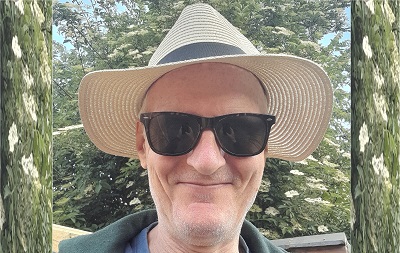
 Simeon McCathal has been writing for 25 years, exploring diverse forms such as web content, non-fiction, blogging, flash fiction, epistolary writing, short stories, and creative non-fiction. Simeon’s work often takes in themes of hope, joy, human rights, media, and life in developing countries, reflecting a deep interest in memoir, diary, and the creative process itself. His work has also appeared in Reverie Magazine, A New Ulster and CafeLit.
Overtaken – Bread and Circuses
By Simeon McCathal
Imagine, if you got a lot of enjoyment from drinking tea or coffee, and you wished for a bottomless cup of either. It would have a rich and enticing aroma, be exactly the flavour and strength you like, the temperature, perfect every time, and you would never get to the end.
You start with your first one or the other in the morning, alternate a bit, and keep returning to them until it’s evening. You don’t want to keep yourself from sleeping. So, you put the tea and coffee away for the night, looking forward, as always, to the first one in the morning.
Would this be an ideal state of affairs? It’s surely not beyond current technology to design a device for beverages, perhaps with a wide selection of tea and coffee styles. Some machines already do it and are available in offices and cafes.
But think of the aesthetic pleasure of enjoying a beverage, made the way you like it, at precisely the time you want it. Think of the smell, the ritual, the ceremony. Maybe there is more to an optimum beverage than having it exactly one way, no more and no less. Couldn’t some of the pleasure be in preparing the beverage, anticipating it, preparing yourself for this sweet spot?
Perhaps not. Perhaps there is a winning format that a machine could be programmed to follow.
Now, imagine the perfect read. A short story, novel or poem. You could even stretch it to a film or serial, or something that you particularly love watching with a beverage to accompany it.
You may have some books or films that you can go back to several times, perhaps many times, but would you want a machine to work out from your reading or watching history what would be the best story or drama for you?
Would you want the machine to create your entertainment, with you only needing to make a few selections, depending on your mood, company, the occasion, the time of day, etc?
Perhaps a machine could also choose and create clothing for you, designing the styles and choosing the colours and fabrics according to current fashions, what your friends wear and what you have been comfortable with in the past.
This could go on, with a machine accompanying you around the golf course and building up your skills without you having to put much effort into it. There could be a machine to pick you up and drop you there, take you from the golf course to the bar, where you could be surrounded by reliable cyber friends, who would always have good jokes, praise for your golfing skills, and perhaps one special cyber friend who will accompany you home when you get tired.
And so on. These machines could do everything for you, with some doing your work in an industrial area that you may never have visited in person. The world would have to be a much smaller place, with far fewer people, using the vast quantities of power, water and other resources required. But those are choices made a long time before. Aren’t they?
Best of all, you know that there are medical solutions to ensure that you are never sick or injured. Disability and congenital conditions have all been eliminated. All this, because machines are entirely at our service. The few of us left.
This could go in many directions, some possibly ending well, and some possibly ending badly. But the question was about enjoying beverages and entertainment. Cărtărescu says that ‘drama is born out of the agonising struggle between hope and despair’. But isn’t everything in life similarly born?
Only the selected humans could survive, possibly in the millions, certainly not in billions. Only ‘good’ traits would be retained, with ‘bad’ ones wiped out. There will be no drama outside of the book or show that you are watching as your beverage is served to you. In fact, drama will eventually cease to have any meaning to those who no longer need hope and will never face despair.
There will be no need to do anything. There will be no need to flee pain or run towards pleasure, as everything you need will be at your fingertips. You won’t even need bodies (with fingertips), or the wetware to house your brain. You would be better off to get rid of your body and replace everything. There’ll be modules that can themselves be replaced or repaired when they wear out.
If you didn’t need the capacity to feel pain anymore, because all pain will be in the past, you wouldn’t need, or even have, the capacity to feel pleasure. Machines don’t need all that stuff. Forget about your companions, because you won’t need other people to be your companions. There will be no dilemmas, such as throwing the baby out with the bathwater, because you won’t need babies, therefore no bathwater, either.
Everything you consider ‘good’ can be replicated, somehow. And everything ‘bad’ kept in a vault, just in case good things can also be evil and vice versa.
It seems unlikely you’d need a planet, either. And all these disembodied brains could fit on a drive. None of this seems especially sustainable, but there’s probably no one left to care. We would have wiped ourselves out, for the greater good, in our final triumph over evil.
Tea, coffee, anyone?
 The Galway Review