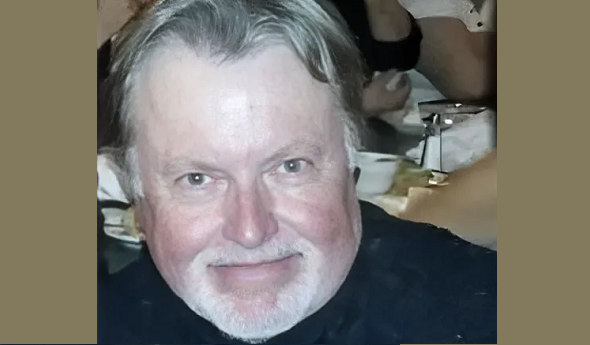
 DB Jonas is the author of two poetry collections: Tarantula Season and Other Poems (2023) and Flight Risk (2025). His third collection, In Dubious Terrain, is forthcoming. Known for his evocative and thought-provoking verse, Jonas explores themes ranging from personal displacement to the intricacies of the natural world. His work reflects a deep engagement with language and form, often blending the lyrical with the introspective. In addition to his published collections, more of his poetry can be found online at jonaspoetry.com.
Animations
Turns out we’re all
the likely product
of some transient
in the prebiotic
saline soup
of early earth
the vicinity of
a proton gradient
somewhere in
the neighborhood
of Godwanaland
perhaps perhaps
some puny piezo-
electric effect
enough to spark
an onset of com-
plexity without
the need for any
flashy lightning
strikes no cause
beside an instance
of the impossible
beside what’s
simply neighboring
no mighty agency
nor primal urgency
besides adjacency.
Urgent Message to K2-18b
If we confirm that there is life on K2-18b,
it should basically confirm that life
is very common in the galaxy.
BBC News
We’ve been busy pumping
dimethyl sulfide out
in frantic quantities
for centuries now, millennia
in fact, eons even, hoping
for a miracle, hoping someone
might happen on these
fleeting signs of life, these
signals of distress, hoping
this semaphoric chemistry
of ours might just perhaps
flag down some remote
awareness in the dark,
some compassionate survivor
of the need to live forever,
as she/he/they/it passes
through the neighborhood,
the robust product of diversity,
a post-capitalist creation,
I envision, emancipated
from our planetary plagues
of nationality, religion, profit
and disease, some lanky,
affable life-form possessed
of a life-expectancy just long
enough to make it here
(and back?), some sturdy
creature fit to make its way
across those light-years
to this place, whose ancestors
had somehow managed
to outlive the folly
of their species, the madness
of their race, and who might
speak to us of other worlds
out there like this, of what
endures, the jeweled nights,
the ozone sweetness
of their atmospheres.
Their Fierce Phonetics
At the edge of the alphabet there is no
safeguard against the dead.
Janet Frame, The Edge of the Alphabet
All the sounds, to them, took place as shapes,
the sounds that formed in the mouths of others,
in the silent speech of written words, the noisy
street, the gurgling ditch, the whir and murmur
of a million fans and motors, daylight’s drone,
the peeps and squeaks of bosomy, cradling night.
But it was spoken words, their specific gravities,
light as pumice, heavy as basalt, the way they
cleared a place and filled it in the mouth, the shape
they made along the haptic tongue, their anxious
rasp against the teeth, their surface planes, their
edges cool, abrasive, jagged, ridged, their awkward
weights and densities, the gutterals that gathered
in the air and clustered in the throat.
So it had been so easy for them, for us, to locate
words once heard, impossible to mislay the shapes
that filled the ear, the eye, the cradling palate,
once their curious weight had settled in, once
they had arrived, occurred like gifts, our myriad losses
left to bloom like crystals in the dripping dark,
the peculiar elegance of their mouth-feel, tumbled
or toothed, the curious eloquence of half-lives living
in the lives they’d led, the stones that gathered
in the chambers of the unremembered past,
those long-forgotten voices of the dead.
Ubi sunt?
Where have all the readers
of Lautréamont gone off to,
who snatched a slice of Rimbaud
with their soup, a hefty hank
of Hopkins at the beach,
a dram of Ungaretti, Char,
of Kleist, Michaux, Cendrars,
Villon, or maybe even Valéry
or Yeats, Tsvetaeva or Dickinson
sometimes, to bed with them,
that such as these might
ease their minds to sleep?
How is it that the frosty parlance
of our narcissistic plainspeak,
the sounding brass of anecdote,
the homely unassuming homiletics
of a diffident sincerity, has muscled
onto center-stage? How is it that
we’d just as soon learn something
new about the world from a quick
perusal of the Classifieds,
or on the crosswords page?
And when exactly was it,
by the way, I cannot quite recall,
that melody removed its clothes?
Exactly when did poetry decide
to dress itself as prose?
Closer
I am what’s closer
to you than light
closer than air
closer still to you
than thought
infinitely closer
than what’s here
than endless night
or crowding day
than what’s
in reach or right
beneath your grasp
closer even
than this you
that it approaches
than that you
who awaits
than the endless
patience it creates
in you in its coming
ever closer.
 The Galway Review