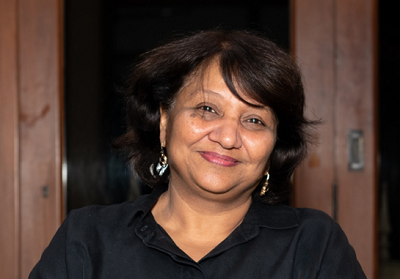
 Madhulika Khaitan, from Kolkata, India has co-written seventeen full-length play scripts for her co-curricular program for children from 1986 to 2003. Her short story fiction has been published in ‘The Riveraine Muse’ and is forthcoming in The Wise Owl. She is currently awaiting publication of her first collection of short stories Of Lives. It is a collection of short stories about Indian women across generations and of varying ages coming to terms in their own unique ways with loving, living or leaving.
Wherever the train stops
By Madhulika Khaitan
Bibi Ramrakhi lived in the hills by herself. Tiny, and to all appearances, fragile – enough for a careless puff of wind to carry her away.
Every not so often, the weather turned more than a trifle blowy and it was all she could do to hang on to her ballooning white garment and float down to the plains. To visit her daughter’s house, connect to her favourite grandson Dibba, feed herself well and revived, return to her more elevated ways of living life. But it wasn’t really quite so simple.
Her other grandchildren had by now spawned their own, much to her consternation, rapidly growing tinies. Great-grandchildren who she didn’t particularly have patience for. They were good at a distance, where she neither had to engage with nor hear them.
Life in the mountains was quiet. Silent. So much so, that of late you’d find her muttering asides, seemingly to no one in particular. This house, she whined, was too full, too noisy, with too many bodies that constantly interfered with her.
Within minutes of her arrival, civility scurried out the door to the unabashed demands of, ‘Get me cotton for my ears you wretches, before you scream yourselves away. I will not deal with this bedlam anymore!’
She was old. Wrinkles etched freely by the elements onto a deeply leathered face. To a great grandchild’s eye, the lines on her sunken cheeks seemed like maps of witch country.
‘Maybe that’s where she comes from. She must live with them, in their dark forests,’ they glared back, nudging each other.
Her eyelids pouched over greying eyes pleading cataract removal which she shunned vehemently saying she was fine with living in a dim world. What would she do with the city colours around. Too garish, she scorned. Too false. Her toothless mouth collected saliva at the corners as she scoffed; the flattened tip of her tongue slipping out tremulously from between her gums.
‘I can see more than you, fools,’ she said. ‘I see what is near and I see what is far. I see what I go to bed with and I wake with it right beside me.’
Bibi RR had a habit of disappearing for short periods of time. When she was gone for a particularly long time, the family was forced to send someone to go looking for her. They feared the worst. That time, she was atop a cupboard. This time, she sits hiding behind the large brass drums containing wheat, rice and various dals. In her hands a half-sucked mango; in her eyes, guilt. On the floor, stones and skin of other mangoes hastily consumed. In case she is spotted, her sticky fingers reach for a cloth pouch tucked into her waist. A quick half-spin and her back is toward the eyes, while dirty, skinny fingers prise open the pouch, rummage through wads of paper notes, pull out a twenty-five-paisa coin before spinning back again. That should keep you quiet, she thinks palming it out to the spotter.
The places she finds to hide in, seem imaginative to say the least. People forget she lives alone in the mountains, can fend for herself, and is as sure-footed as a mountain goat.
She could emerge as easily as she disappeared. As suddenly and soundlessly. And hang about longly, sniffing out the air at places and events where she was not wanted. There, she simply stood. Generally, in an innocuous corner between entries and exits to rooms. Privacy was a word foreign to her brain. As an elder, it was her right to know everything that happened in the house. It was also her duty.
Night is falling. Ramrakhi is busy in the kitchen preparing her daily hookah. She has poured water into the clay bottle, placed the loose tobacco into its clay cup, and is by the kiln with tongs to grab a few unlit coal pieces. Toddling out of the kitchen to an adjoining little terrace she sets down her hookah by the wall, scurries back inside to get a light, comes out with a twisted newspaper in flames to light her coals.
‘Yes… yes… I know…I feel a coldness even as I feel its heat…’ she mumbles as if to someone beside her.
She waits till the coal is a glowing orange before adding it to the tobacco, settles down on her haunches against the wall, eyes half closed in anticipation of the pleasure that is to come. Her toothless mouth moves up and down chewing on nothing before it opens to let in the nozzle of the hookah’s pipe. The first few puffs are short, stoking the coal. Then a long pull, dragged in to the accompanying sound of air gurgles passing through the water before it reaches her insides. A few more puffs and pulls and Ramrakhi relaxes, the flickering of the fire trapped in her faraway eyes.
An overhead lamp in a tiny room lights Dibba, its green metal shade creating a tight circle around him as he sits at a desk poring over a thick book. Cheiro’s Book of Numbers says the cover. In smaller print, it also says:
Numbers and names and the date of our birth have profound effect upon our lives. All these things are not accidental and everything happens at the precise time, as the Universe is choreographed to perfection.
On his left, on a low table concealed from sight, sits a glass of stolen alcohol reaching his lips at regular intervals; his right side is busy flicking pages of the book and taking notes. He has other Cheiro’s piled on the desk but this one is his favourite. Ramrakhi pushes aside the curtain by just an inch, peers into the room, and takes a few steps forward in the near darkness that makes her turn as blind as burnt coal. Losing her balance, she staggers in with a series of pain-filled aarghs and shrieks as she bumps and trips over things that come in her way. Dibba has his glass raised to savour the last few sips. It’s a violent shake-up for him decelerating into a cascade of shudders as his glass jumps out of his hand, the contents swirling in the air before sloshing tipsily onto the floor. It is a small room; a few unsteady steps and the old woman lurches forward right into the distraught arms of her favourite grandson.
‘Dibba!’ she yells.
‘Dadi!!’ he screams.
Unceremoniously divesting himself of her bodily presence, he moves to switch on the only other bulb in the room. Light reveals Ramrakhi on her knees crawling around sniffing the floor, lifting drops of wetness to her puckered mouth that puckers further at the taste that fills it.
‘Down Dibba!’ she commands, as she reaches for his ear giving it a hard twist. ‘So, you’re at it again, is it?’
‘But when did I stop Da?’ he retorts cheekily looking right into her eyes. A tight, sharp rap at the back of his head ends the conversation.
The small terracotta gurguri gurgles pleasurably as she draws upon it. Today’s igniting has yielded a small mound of ashes by her side. Her fingers run through it making idle patterns.
‘Tickling you, am I?’ she giggles furtively at the cinders.
Her grandson leans against her, playfully pulling bits of her white sari here and there, teasing her. She looks at him expectantly, wondering when he is going to begin a session with her. Of predictions for her future.
Finally, Dibba rises to the occasion.
‘Old woman, very old woman, you’re not going anywhere in a hurry, you aren’t. Like those old banyan trees that live on and on. Da, you’ll live another hundred years. Right?’
Thrilled to think that Dibba has been doing numerical calculations all the while he’s been with her, she tweaks his cheek fondly. Her smile is shy. On the quiet, she’s been so desirous of hearing those words – a long life.
Suddenly she looks around as though missing someone.
Then under her breath she scolds, ‘Stop hiding, come and sit by me. Don’t sulk.’
‘Let me speak of other things.’ Her grandson interrupts her muttering. ‘Numbers. Or the Palm. Which do you want? Choose.’
‘Numbers. Numbers, son,’ she says, ‘tell me when I will go Vilayat…’ Her face breaks into a bigger, broader, gummier smile as she goes back to her gurgur gur gur gurgurgur.
Dibba writes a few numbers, pretends at some calculations.
‘You will go back home in three weeks. You have some money that you brought, you will give or use it here,’ he says, tugging at the inseparable little cloth pouch that hangs by her waist. ‘But there is much more where that came from, so do not worry,’ he consoles.
Ramrakhi picks up a handful of ashes and throws it at him in a show of flirtatious pique.
‘Dhat! Ullu ki dum!’ She swears.
The evening leaves delightedly as grandmother and grandson tease and play into each other’s hands.
Some such evenings later the hookah finds its place before a wall between the kitchen and the scullery. This offers a better view of the staircase. Something tells her Dibba is going to be late. She goes down on her haunches, leans against the wall, a few extra coals light the clay bowl, draws her first puff and begins her wait – head tilted to the right, eyes turned to her left, fixed on the banister.
‘Oh! so that’s where you are.’ She says relieved. ‘It’s not that I was looking for you, but if you go missing, I wonder who you are stalking. It better not be my grandson.’
She has added more tobacco. Re-done the coals smouldering with orange heat, when the first sound wafts up. Foot stub at the first step, uneven breathing, an uneven tread. Slowly a hand appears mid-banister, vanishes, clutches on again, leaves, then comes heavily down once more for support. A light thumping of bare feet followed by the appearance of a bent-down head and a swaying body complete the sneaky picture. His other hand holds his shoes as Dibba tries to balance his foot on the second last stair. Ramrakhi is up like a shot. Whooping out a war cry she runs with her hookah and flings the burning coals under his feet. Dibba, like the melodic cat on a hot tin roof, agonizing. Doors fly open, some bang shut as most of the family gathers. A common sound of resignation. They turn around and walk away without a word.
The following sundown sees him, squiffy glass in hand, a veritable male Cleopatra lying crapulously on his side as she chats through the sounds of a bubbling hookah. Both souls content with the heat of fire in their bellies. Liquid fire. Smoked fire. Some minutes of amicable silence follow before she begins her indistinct jabber.
‘Who do you talk to mad woman?’ Dibba prods her half-fondly.
‘A companion,’ comes the reply.
‘Oh. And what does she do looney Da?’
‘Nothing, just sits by me.’
‘Okay enjoy!’ he shrugs, giving up on her.
‘When will I go vilayat? You never said.’
‘You’ll go if the time is right. When the time is near.’
Things come to a pass when he predicts her death through drunken numerical chicanery as he matches numbers to each letter of her name for the first time.
‘What is your birth date?’ he asks.
‘Twenty-six days after the flood.’
‘Twenty-six adds up to eight which numerologically means destruction. You will die anytime Bebe.’
Her faraway greying eyes turn dark. ‘Yes, the heart can stop any minute,’ she murmurs.
‘Unless you give me your money pouch.’ He teases.
‘Shaitan ki poonch! Go jump into the well!’ Dadi curses. Then scolds the world at large. Then falls silent.
The next day Dadi and the sun leave together. One member from each generation of the family accompanies her to the station to see her off. They are late. Amid the loud announcements, the bustling red of coolies, yelling of passengers and hawkers and the screeching of the child that has also come along – it’s been a mad scramble to get the old woman, her bags, her bedding and food for her journey onto the train and into the right compartment. All fifteen pieces of them.
She sits by the window her nose glued to the glass, feels that familiar lump in her stomach as the engine jerks the train to life, keeps waving out at the receding backs of her family trooping out of the station. Before she knows it, she is fast asleep.
Ramrakhi awakens to a hush. A still train. Its seats deserted. An unknown platform. No people. And darkness.
She takes the smaller pieces out first. Then rolls down the larger bags, one by one, like boulders loosened in an avalanche. Finally, her luggage forms an untidy, desolate pile. She leans against the heap for a few minutes collecting mind and breath together. Rummaging inside a bag she pulls out what she needs; hands full, she moves back and forth on the long barren platform, each slow, shuffling footfall greeted by a hollow echo till she chances upon a solitary hawker making tea.
‘Fire at last!’ She whispers. ‘Is this vilayat?’
The one small bulb over the platform goes out. Darkness drips an inky black broken only by a yellow glimmer a long way out on the tracks. The air is laden with the weight of soundlessness lacerated off and on by a volley of sudden barks or howls. Some of the inkiness is blotted up as the tea man stokes the coals back to life again. The yowls and barks seem to have fallen off. He looks out in the direction of the old lady.
In the distance, a diminutive figure sits atop a mound of luggage. She has lowered herself onto her haunches. The hookah nestled in her hands, the woman in white rocks herself back and forth as the sound of gurgles escapes into the air.
‘How much more are you going to delay?’ She asks of the nothing by her side. And waits.
Glossary:
Gurguri – Small clay hookah
Vilayat – Foreign land
Ullu ki dum! – Tail of the owl! (mild expletive)
Shaitan ki poonch! – Tail of the Devil! (mild expletive)
Dadi – grandmother
Da, Bebe – sobriquet for Bibi Ramrakhi
 The Galway Review