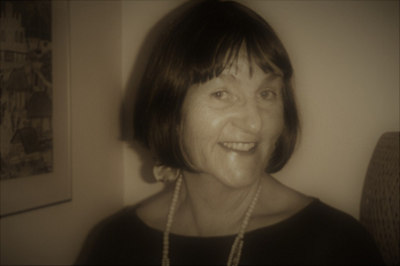
 Born and educated in Northern Ireland, Angela Mairéad Coid now lives in Vancouver. “Know who you are. Know where you came from,” she comes from a family of storytellers. Her work has appeared in Boyne Berries, Canadian Woman Studies: Women of Ireland Mná na hÉireann, The Antigonish Review, The Windsor Review, GEIST, WordWorks, The New Quarterly and carte-blanche.
All Creatures Great and Small
(County Antrim, 1910)
By Angela Mairéad Coid
Louie sat by a box at the side of the fire stroking Molly, her father’s setter. The bitch had whelped that afternoon; her fourth litter and she was an experienced, if worn out mother. Louie’s eldest brother, Hugh, glad of any excuse to be in by the fire on a bitter March day, helped with the whelping. One stillborn pup he had tossed on the dung heap outside before rushing off on some errand of his own.
“Louisa! You’d better lock them chickens up in the henhouse before yer father gets back.” Her older sisters, Ellen and May were doing the dishes and pots and minding the baby, her mother resting her throbbing varicose veins. Being a mother of seven, supervisor for the care of the farm animals and cook for three meals a day won her a cup of tea in the evening and a prime seat by the fire with the weight off her feet.
The dusk would turn soon to night outside and because of her terror of rats, Louie wished she had done her job sooner. She slipped over to the table where Jack, the chosen scholar sat over at his copy book, to pull on his sleeve and point at outside. Kind Jack, he knew her fear.
The two slipped out the kitchen door. Louie carried the egg basket in case more eggs had been laid since the morning. With Jack’s company, the dark of the henhouse proved not so frightening, and they quickly found five warm eggs for the basket, one surely a double yolker. Chickens locked up, Louie paused where the dung heap steamed in the evening air and sniffed in the fruity pungent smell. Her older sister, May would laugh at this habit of Louie’s and called her, “Miss Cowpat”, but Jack only smiled.
“I know, Louie. When I get back from school, it’s the smell of home, and the country.”
“Jack, listen. Is that a rat?” A squeaking was coming from the dung heap. Jack, curious, crossed to the heap, a stick in his hand. Then he turned to his shivering sister, a grin on his face, and beckoned for her to come close.
“Look! It’s that wee dead pup our Hugh threw out! Go fetch the towel from beside the pump.” Jack wiped the pup down with some clean straw and gently massaged its tiny body, then offered it to Louie, who wrapped it in the towel, her ‘wee baby’, and she cradled it warm and safe under her woolly jumper, a hand-me-down from May.
In the kitchen, except for the absent ‘galivanting’ Hugh, the whole family crowded around the heat of the fire. Baby sister Vi played on the hearthrug, prevented from crawling into the flames by the sprawling body of May. “Miss Cowpat, you stink like the dung out there!” big sister May mouthed her disgust, but Louie ignored her. She and Jack had a special surprise for their father, home now with an older brother Gerry from work at McNaughton’s stables, both of them lathering praise and attention on Molly, she in turn licking and suckling her newborn pups.
Jack pushed in to where they sat by Molly’s box. “Daddy, Louie found this wee pup o’ Molly’s on the dung heap. The heat must have revived it.”
Their father took the bundle from Louie, and chose to ignore his youngest son, Jack holding the egg basket, which was girls’ work. Without having to be told, Gerry eased a dried blood-stained rag out from under Molly and gave it to his father to cocoon the pup in the scent of his mother.
“Jack. Crack one of d’ose eggs into a bowl and feed d’yolk to Molly wid your fingers, and Gerry’ll put de wee’n on her teat. Let Molly smell ye, Jack. I do not want her to reject dat wee dog.”
“Daddy. I found him. Can I have him for my own?” pleaded Louie, who was her father’s favourite before the arrival of Baby Vi. “He’s a wee runt. And I’ll take the best care of Molly too.”
“Quiet, girl! Molly needs a bit a’ peace.” Her father kneeled down and examined his setter with caring hands. Then the pups. “Small litter,” he looked across at his wife on her chair on the other side of the fire. “Molly’s showing her age. Only two wee bitches and t’ree males, one a runt.”
Gerry smirked at Jack, the sons’ private amusement for sometimes their father let his Dublin origins slip out on his tongue, that same soft accent that had wooed their mother when she worked for the McNaughton’s, a parlour maid in the Big House, and he was McNaughton’s coachman. After their marriage, they became tenant farmers on the estate, but “His Lordship” still valued their father’s opinion and vetting of any ailing horse in his stables. The second oldest son, Gerry appeared to have inherited that gift, a way with animals, and he had a job up at McNaughton’s the day he turned fourteen, the school leaving age. Some would hire thirteen or even twelve-year old’s but not McNaughton, who harboured ambitions in politics and nursed a reputation of living by the letter of the law.
“It’s hard on her, John.” Their mother rose from her seat and bent to put her arm around her husband’s shoulders, “Another litter’ll kill her. Kinder to put her down before her next heat.” Then in a loud voice she ordered, “Girls, bedtime. You too, Ellen, if you’re to get up in time for your work.”
All the girls and their mother slept in the same bedroom. Ellen and May in one bed, and Louie, her mother and baby Vi in the big bed. The boys and their father slept in the other small bedroom. Jack who shared a bed with their father, confided to Louie that his snores sounded like the sawmill, but never had he been warmer in bed than beside that enormous shifting mound. Since the birth of Baby Vi, this had been their parents’ sleeping arrangement.
*
With a gradual diet of goat’s milk and syrup, the pups by eight weeks were weaned, leaving Molly, with her dugs, dry and enormous, and her, a dull red fur draped over a rib cage. Their father sold the four biggest pups, and kept Barney, the runt for Louie’s lavish attention and training. Molly observed it all with her sad eyes.
“M’ poor auld darlin’ Molly,” was their father’s refrain the morning he gathered Molly in his arms to bring her up to McNaughton’s for the gamekeeper to put her down.
Molly’s son, Barney trotted at Louie’s heel on her morning and evening visits to the henhouse, guarding her from rats. A few cracked yokes eggs slipped into his eager mouth—when he did as he was told— and frequent grooming had him evolve into a fine gentleman of an Irish setter, if a little on the dainty side.
“I’d like to see that fancy boy top a bitch!” laughed Hugh, whose latest passion was the racetrack and greyhounds. “The poor man’s racehorse” he boasted to his father.
*
In the final week of June, the family anticipated Lady McNaughton’s visit to the cottages of the tenants and the workers on the estate. Her yearly, rather superficial inspection―for that is what it was―excused itself with a small gift basket for every kitchen: some tea and a few fine foods above the income of most of those households’ budgets.
When the clip clop of the trap was heard on the lane, the parents and those younger children not yet employed at the estate, rushed to the front, as far from the dung heap as they could muster and plastered welcoming smiles on their faces. It was a large trap drawn by two spirited ponies. Lady McNaughton could handle horses, her Irish tenants, and a rifle. She adored ‘the shoot’. She favoured their mother, even had thought of promoting her before Lord McNaughton’s coachman appeared. Most of all her ladyship loved her dogs, better than her children, the whisper went, and decidedly better than her husband.
Barney sat at Louie’s heel, tolerating Baby Vi’s occasional pats. He was better trained than Vi who made a determined stagger toward the trap when it stopped, so eager was she to practise her new skill at walking. Barney rose to follow but a sharp “Sit!” ordered him back to the family’s line up.
“What an excellent coat your setter has. How many months?”
Without looking to anyone, and getting down from the trap, Lady McNaughton held out the basket and May grabbed it. “He’s petite, but if agile and fast that is good in the field. Is he fast?”
Jack and Louie who had exercised him, nodded their heads.
“Come!” Her ladyship’s command obeyed, Barney goofed over and expected a caress, but instead a quick pat and he was made to stand; Lady McNaughton put one dainty gloved hand under his chin and the other hand under his backside―under his boy dog parts.
“Stand!” Barney looked as shocked as the children could imagine a pup to be, but he stood.
“What a fine red coat. What is your price? I know who bought one of your bitches, more of a mahogany she is.”
Their father named a price. Their mother added “Guineas” to his sentence, for that was how the gentry priced things they treasured.
“Done! I shall name him ‘Flame’, a good name for an Irish setter and I will send someone with the guineas on Monday to collect him. You have raised a fine family, Annie.” Choosing only to compliment Louie’s mother, her ex-parlourmaid, Lady NcNaughton climbed up into the trap to finish her rounds.
 The Galway Review
Beautifully written!