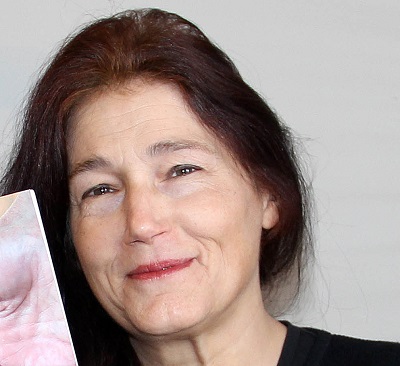
 Laura Rodley, a Pushcart Prize winner, has been nominated for the prize seven times and has also received five Best of the Net nominations. Her recent works include Turn Left at Normal (published by Big Table Publishing Company), Counter Point (published by Prolific Press), and Ribbons and Moths: Poems for Children (published by Kelsay Books). With a talent for capturing the essence of life, Rodley’s writing resonates with readers of all ages. Whether exploring the natural world or delving into human emotions, her words evoke a sense of wonder and connection. https://www.youtube.com/watch?v=PClY8G6HQwk
Sinker
By Laura Rodley
Her father had always wanted a boy. Like, Dude, that should surprise anyone. He never liked women, never liked her mother—her mother told her often enough. That’s why he left, her mother said, though Phoenix wasn’t sure. Maybe it was because when she was sixteen, Phoenix wore loose plaid shirts hiding her pregnancy until the seventh month, long past time for anyone to change her mind. Her seventh month brought her just past her seventeenth birthday when she could make her own medical decisions.
Maybe it’s because she gave the baby up for adoption, the way she planned, instead of keeping it for her mother to be its grandmother.
“You gave away my grandchild,” her mother screamed. Phoenix mused that her mother had just wanted someone else to yell at, be disappointed in, as she adjusted the strap on her beige Carhartt overalls, swept her long brown braid under her Carhartt jacket, bent down again to saw through the ice. Her mother hadn’t sent her to live with nuns, not that anyone did that anymore, but that was because Phoenix had a prize to give her, and Phoenix had given the prize away. She tightened the red wool scarf that her mother had knitted for her in the days before the baby came around her mouth and nose.
Nothing she could do about it. She quit school, didn’t want to have classmates remind her about it by their knowing stares. Others in her small town knew about the baby, ones that paid attention; for those that didn’t, her mother never shut up. Then her mother was gone, snap, just like that, a brain aneurysm.
Never expected that to leave a hole in her heart, like the dark hole she cut through the ice with her jigsaw through ten inches of hard ice on the lake in Brattleboro, never thought she’d miss her. Darn, she tipped the line down into the water, adjusted the red flag on the short tip-up line that was fed down into the ice. The red flag bent down when there was a bite, so she didn’t have to be constantly attending the line, as she sat on her canvas chair, adjusted her worn arctic-proof fleece gloves, thumbs and forefinger taped with silver duct tape. Not for her the cozy ice houses, butane flame stoves for warmth—that cost money.
Almost daily she fished for her dinner. She had a standing order to sell fresh brook trout to the local market, not that it was easy to fill, and two restaurants. Fishing was a crap-shoot, not like getting pregnant, for her anyway. Getting pregnant was apparently a sure thing. Not that she was
letting anybody get close to give that another go. People judged her for that too—being alone. Was there no end to judging? At least trout didn’t talk. The ice moaned sometimes, creaked, if you went too close to its edge, but at least you knew where you stood with that, or on it.
Today was her lucky day, for the tip-up line’s red flag bent down, signaling she had caught a fish. She was reeling in the line when two boys started yelling at her. She ignored them, as always, to pull the fish up. A ten-pounder. Couldn’t they yell at someone else? Looking around, there was no one else, no one else with free time on a freezing Wednesday morning.
She put the fish in her cooler, stamped over in her insulated boots, keeping track of the edge of the ice, its telltale round bubbles warning of approaching thinness. “What is it?”
“My Dad,” a boy twisting a hat around in his hands burbled. “He’s bleeding all over his leg. He was chainsawing firewood and the saw slipped.”
“Where?”
“Over here,” the boy pointed. His younger brother stared mutely, eyes round, blonde hair sticking out in all directions from static electricity, his hat fallen off, trampled in the snow. Both their coats hung open.
Raising feet high through the snow, they tramped to the parking lot. Leaning against the beat-up white Chevy truck, a man groaned, holding his hands over the top of his left thigh as blood pumped through his fingers, wood piled on the ground, dropped chainsaw and blood tinting snow pink.
“You gotta be kidding me,” Phoenix rushed over. “I lost my cellphone. Do you have one? Call 911.” As the boys held up a cellphone with no bars, “That’s right, no service..”
She unwrapped her red wool scarf, “You need to have more pressure on that,” pulled the man’s hands away, as blood spurted, wadded her scarf against his wound, holding firm. “We need an ambulance,” she told the boys, unwilling to add that their father might be close to death. “See that house over there? I saw a lady drive up a few minutes ago. Knock on her door, tell her call 911. Wait, I need your scarf, only one of you can go. What’s your name?,” she asked the older boy. “Teddy.”
“Teddy, give me your scarf. Hold your hands on this scarf like I am. I’ll wrap your scarf around his leg to make a tourniquet. Keep your hands there, don’t take them away till I say so.”
Teddy offered his scarf, his brother stock-still.
She asked, “Do you think your brother can knock on the door?”
“No.”
“Ready?” She pressed Teddy’s hands down as she tied his scarf tightly two inches above her scarf. His face white, the father moaned, fainted.
“It’s OK; he’s lost a lot of blood. Teddy, release your hands slowly, as I take over. Now run. You, little brother, hold your father’s hand. You’ll feel better.”
Teddy arrived back before the ambulance, said the lady called for one right away. Waiting for the ambulance felt as long as a hidden pregnancy. Maybe all the reading I’d done on first aide in case I started labor and had the baby while I was alone has paid off, thought Phoenix..
Sirens ringing, ambulance arrived, paramedics spilled out. “We’ll take over.” One checked the makeshift tourniquet’s tightness. “We’ll leave this where it is. Holding up padded cloths, one instructed Phoenix, “As you release your hands, we’ll slide this on him. You’ve saved his life.”
As they lifted the boys’ father into the ambulance, Teddy held his brother’s hand, then grabbed Phoenix’s arm, “She’s riding with us. Please. She’s, like, my big sister.”
“You bet,” said the paramedic.
 The Galway Review