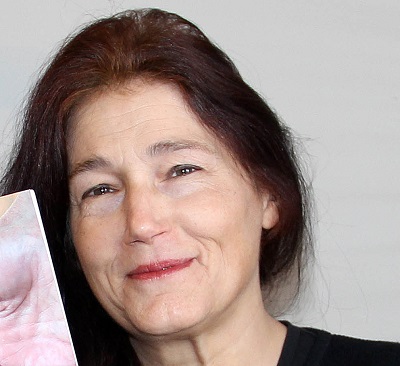
 Laura Rodley, a Pushcart Prize winner, has been nominated for the prize seven times and has also received five Best of the Net nominations. Her recent works include Turn Left at Normal (published by Big Table Publishing Company), Counter Point (published by Prolific Press), and Ribbons and Moths: Poems for Children (published by Kelsay Books). With a talent for capturing the essence of life, Rodley’s writing resonates with readers of all ages. Whether exploring the natural world or delving into human emotions, her words evoke a sense of wonder and connection. https://www.youtube.com/watch?v=PClY8G6HQwk
Lambing Season
By Laura Rodley
The Karma Squad were limited to their particular geographic location. They tested their boundaries constantly but were met by bouncing waves of energy that spun their tires off their axles of their tiny motorcycles and gave them pounding headaches. The very ground undulated as though it was an ice flow on an ice road, moving up and down from weight of three-ton trucks. All five of the Karma Squad had sat on the windowsill of Lucille’s house and watched Liam Neeson as he drove his truck in Canada. For the fairies of the Karma Squad, Liam was not acting in the movie “The Ice Road;” he really was driving the truck in the movie and fighting with the bad guys. They punched the air in his favor, but again, they were limited by the geographic boundaries of the forest they inhabited.
At one point, not so long ago, they helped farmers working this very land at lambing time by singing songs to baby lambs in the minus-fifteen degree weather that were born at holiday time for Christmas dinners and in February through April for Easter suppers, and others, for wool. Dalphine’s grandmother Eunice held lamps made of foxfire and flickered them to let a farmer know when a lamb was lost, if a ewe had birthed it and left in in the snow, especially a first-time mother. The farmer, in this case, farmer Lucius Brown, thought he was seeing the flickering lights because he hadn’t slept for weeks, but Eunice drummed her wings and bobbed her foxfire lantern until he rubbed his eyes, followed its flickering and picked the lamb up out of the snow, snuggled her under his overcoat. He had a kitchen full of tiny lambs—four of them—though his wife had said her kitchen was full, that he kept near the hearth fire and fed with bottles. It was a last resort, — taking lambs away from their mother—but if they were too weak to suckle or a first-time mom had rejected them, then he had no choice. Sheep were the only viable crop on the rocky soil with a such a thin layer of topsoil.
This year in particular he was coughing, wheezing, barely able to manage. His wife Elsie pushed a plate of bacon, liver and fried potatoes towards him but he couldn’t eat. A farmer must be Hercules but Lucius felt like a wilted onion, no pep in his wiry five-foot-five frame, all his juice gone.
“You’re burning up,” Elsie said, as she set his tea by his hand.
“Too bad; Shep says there’s lambs and so there’s lambs and so I must go.” He clapped his beaver hat on his head—the beaver he had trapped himself—and held the clothesline strung from the house to the barn in the whistling wind to save him from being lost in the snow and followed his border collie Shep to a pile of snow in the leeward side of the fence. He dug the snow away from the pile where Shep was digging, and saw a hand. “Not a lamb a’ t’all,” he murmured. Little lights flickered to his left and right as he and Shep dug but he ignored them. A hand, small as a girl’s and then a face, a child’s face, her hair long and blonde splayed upon the snow, crusted with ice. The only good thing she had on were deer-hide boots. He lifted her up, set her over his shoulder as Shep barked and the fairies leaped and did somersaults and patted Lucius’s face with their own tiny hands. He thought it was snow pelting him, and as his hands were full, he couldn’t wipe them away. Shep, however, saw them clearly, and leaped up to lick their faces, which was an idea they kept well away from. The fairies frittered in the air all the way to the door which Lucius opened, staggering in. Usually he slammed it shut but his arms were full. Two of the fairies waved their way inside to keep an eye on the girl. They blew on her closed eyelids and danced on her hands to warm them.
Elsie lay the girl on the day bed where they sat near the hearth, covered her with blankets she herself had woven from the sheep’s wool. “You brought me a fairy girl,” she said. The fairies laughed, “Right you are, right you are.” “Turn away Lucius, while I undress her. Ne’er mind, I’ll need your help, I can’t get her clothes off her, they’re frozen onto her body.”
Before Lucius could reply, he pitched forward onto the hearthstone, unconscious. “Two of you! No one to send for the doctor,” Elsie cried as she struggled to lift Lucius up under his arms, get his wet coat off, drag him to the bed, cover him, unaware that the fairies were holding his feet up by his pant cuffs to help her drag him. “You’ll have to wait till I get this girl undressed and in warm nightclothes or she’ll surely die; she’s half dead already. Did you notice the bead work on her boots? She must be a Gypsy—but with blonde hair? Don’t you die on me, you old bugger.” She returned to the girl, her frozen clothes already thawing from the heat of the fire, water dripping and steaming on the hearth stone, struggled to lift her arms, fit them into a nightgown, and pulled wool socks onto her still-frozen feet.
 The Galway Review