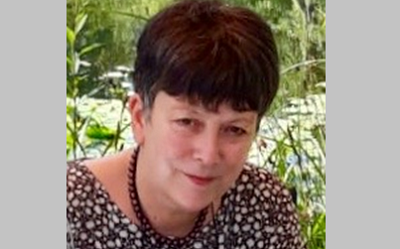
 Mary O’Brien writes in both English and Irish. She has published five collections of poetry in English and one in Irish with Coiscéim, Dublin. A bilingual collection, Púcaíocht/Shapeshifting was published in 2023. see maryobrienpoetry.com. Her work has appeared in many journals countrywide. She has been the winner of Duais Fhoras na Gaeilge at Writers’ Week in Listowel and has featured on the shortlist for the R.T.E. Francis MacManus short story competition. She lives near Wexford town, Ireland.
Visits and Revisits
By Mary O’Brien
And there I was, reading that story again. As Oliver would say – obsessed with it…
The house stood about two miles from the road down a long narrow winding lane, rough and untarred, with a high ridge of grass growing down the centre. The Morris Minor bumped slowly along, whining slightly under its full load. At last it came to a stop outside the house at the very end of the lane.
Martha appeared and stood in the doorway wiping her hands on her blue and white cross-over apron. Her dark hair was pulled back from her strong-featured face and coiled into a neat bun at the back. Her colouring belied her near forty years and in her thick grey stockings and heavy black shoes, she looked the picture of solidity. Two collie dogs barked frantically at the unloading visitors and the two girls looked warily at the long-tailed and muzzled greyhound that sniffed vigorously at the bumper of the car…
Yes, there I was, reading that story again. It was during the clear-out I had unearthed it. It seemed like the small basement had never really had a good clean out by previous owners. An old broken cupboard in a corner was covered with dust and cobwebs and it was when we went to move it that we came across the battered boxes and piles of typed manuscripts. This was the first and only evidence which led us to suspect that this small townhome we were about to downsize to had once housed the offices of a magazine publishing company. The real estate agent could tell us nothing. Most of this find of dust-covered paper was faded, stained and unreadable. It went straight into the trash. A rusted tin box had protected six of the manuscripts, just about, brown and faded but still readable. It was in that rusted tin box that I found that story, the story I began to obsess about, well that’s what Oliver said I was doing, obsessing. And yes, I was reading and re-reading, visiting and revisiting, finding in it some strange attraction.
… The gravel crunched as the party strolled towards the house, accompanied by the bounding dogs. Dismissing the dogs, Martha was all smiles of greeting and comments of admiration for the children’s clothes as she ushered them inside. The hallway was small and the heavy wooden hall-stand was laden down with long black coats and surrounded by open-mouthed wellington boots. They passed through into the large kitchen. Smells mingled. There was the pungency of the burning logs from the open fireplace, the smell of dogs, greyhounds. The whiff of flour came from two cloth flour bags which stood against the yellow distempered wall at the lower end of the kitchen. The aroma of hot bread lingered. There was the hint of burning straw which Martha used to make a blaze under the huge greyhound loaves she baked for the dogs most days in the heavy metal bakepan hanging by its long handle on the pot rack over the fire and from somewhere there was the smell of butter, salty home-made butter, the dreaded so-called farmer’s butter…
That story, titled Martha, was typed on an old typewriter and had no details of who the author was. I thought this odd but guessed, when I read it, that it must have been sent from Ireland. I had no Irish roots which made me wonder even more at how I felt, disturbed, somehow haunted by that story. I would ask Oliver. Oliver had Irish roots going back – his great-grandfather had come over after the Irish Famine. This explained his interest in Irish traditional music. My own interest was always a source of puzzlement to my family as our people had come from Germany and there was no record of anyone of the ancestors ever having any interest in things Irish, let alone playing the concertina. It was one St. Patricks Day when I was eight years old that I had first seen children playing Irish traditional music and began, to the great amusement of my parents, to pester them about joining a group. It took a while to find out where the Irish Centre was and with their help, where the nearest classes for young people were held. But from the beginning I was hooked and so began the weekly lessons and the annual trip to the Mid-Atlantic Fleadh, the Festival of Irish traditional music. I was a very good concertina player, did well in the competitions and the cabinet began to fill up with medals and trophies.
… Martha’s brother appeared and sat awkwardly for a short time before escaping for a stroll in the sunshine with his visiting brother. The women remained. The children sat, hands on laps, beside their mother on the worn leather sofa. The old woman, in her nineties now, totally blind and almost as deaf, sat upright in the huge black armchair directly opposite the open fire at the edge of the wide hearth. She was dressed in black from head to toe, her white hair tied back into a bun. She sat silently, her eyes closed, apparently unaware of her surroundings. Martha talked, hovered and moved from cupboard to table to fire and back. She turned the wheel of the fanners which made a pleasant rhythmic sound caused by the clicking of the loose wooden handle. Long tongues of flame licked up around the black kettle which hung on the pot rack. The wide open chimney yawned upwards coated in thick shining soot. The old woman shifted her body restlessly. Martha motioned to the children and they went and stood by the big chair. One after the other the old woman gently placed her two hands on the young heads and her thin fingers traced slowly over the soft features of the faces and down along the sturdy bodies. The women watched silently. The old lady was satisfied…
Finally, with that townhome cleared and cleaned and some furniture in place, the family came over for the house warming, which, this year was also serving as a wedding anniversary celebration. We were forty years married on the day. I had met Oliver through the music. He was a fiddle player. We’d married young and had the two kids in our twenties which left us later in life with plenty of time and energy for ourselves. Things had worked out very well. There was a time when we brought the two girls with us to Ireland for the yearly traditional festival, the Fleadh Cheoil. Both of them were good singers and had enjoyed tin whistle lessons when they were young. Now grown up, they had their own interests, their own lives to live.
… Reaching up at the dresser, Martha took down the white brocade tablecloth and some napkins from the top shelf beside where the concertina lay. The girls had only ever once heard Martha play the instrument, years earlier, on a visit when they were much younger. On a later visit, when one of them asked, their mother had said that Martha didn’t play it any more. She was too busy now looking after their Granny and the greyhounds. The table prepared with the good china, Martha swung the black crane forward and tilted the kettle until it had filled up the tall tea-drawer. She placed the tea-drawer in the ashes near the red coals at the side of the hearth. The tea would become strong and black, ready to be transferred into the fancy ceramic teapot with the red robin on it.
Mother and girls were then seated at the table by the window under the ledge where the big wireless stood. Little light came in. Thick green ivy hung around the window and through the white net curtains the children watched the heavy boughs of the big cypress trees sway in the breeze. The house was surrounded by these big evergreens, enclosing and darkening and in about a month’s time, as autumn deepened, the ground would be littered with cones. Every now and then a great sigh would sweep through the evergreens, but only now and then, for mostly they stood silently, watching, waiting.
Martha breathed close to the children’s faces and offered thick-crusted apple cake and big doorsteps of white loaf grooved with the pungent farmer’s butter. The strength of the tea was well matched by the milk, creamy and strongly flavoured by the herbs and last of the summer wild flowers. The children ate cautiously but obediently under the watchful eye of their mother. Martha brought a cup of tea and a plate of bread to the old woman who fumbled at first until she found her grip and then ate silently, breaking the bread into small pieces. A gush of smoke billowed out from the wide chimney and dispersed itself upwards towards the oil-cloth covered mantel board above the fire. There was the sound of the men chatting as they approached. Martha reached up beside the concertina again and brought down two more white napkins. The tea drawer was filled again as the men entered and Martha took the cup and plate from the old woman and placed them in the enamel basin which she took from the stool beside the wooden milk churn. The long handled besom fell over and she stood it up in its place again and went to set the table for the men…
This year, as an anniversary present, the family had gifted us an extra week in Ireland for the music festival. As well as re-visiting the festival, the week of sessions, concerts and competitions we would have time this year to rent a trailer and travel round a bit. I was hugely excited about this due particularly to my finding that old story written in Ireland. I continued to read and re-read. I had asked Oliver about words I didn’t understand, among them – crane, tea drawer, fanners, besom. He suggested I google. I had him read the story again the day before our flight to Shannon Airport and on the plane that morning had asked him again what he thought about it.
‘Too old-fashioned for me’, he apologised. ‘ Another time, another life. A story’s gotta have something to do with my own life here and now. Gotta be sorta relevant.’
‘But I think for me… I have this strange feeling that…’ I decided not to press it further but when he dozed off beside me that morning I slipped the story out of my bag where I had it carefully folded in a brown envelope and began to read again.
… The children wandered from the house to the garden. The huge trees sighed again as the girls made their way round by the almost overgrown path towards the back of the house. The path ended abruptly among briars and tall out-of-control shrubs. A dead end. Some old gooseberry and blackcurrant bushes were visible in the mass of smothering foliage. Ivy trailed up the walls of the house in long clasping tendrils and moss was beginning to grow on the roof tiles. In the heavy stillness of the early autumn afternoon the girls wandered about the farmyard. All the doors of the outhouses were closed and from behind one door they could hear steady breathing, the sound of dogs moving around. Here and there around the yard lay scattered bones and the odd skull, remnants of the dogs’ food. They lingered near a gate to a field where the skeleton of an old car lay rusting away among weeds and grasses and watched the lowering sun shine steadily on the green surface of the stagnant water in a cement tank. Then a voice in the distance. It was time to go home.
Martha walked the family to the car as the dogs hovered, more friendly now, wagging their tails. As the car moved slowly into the lane Martha stood waving in the dappled shadow cast by the big cypress. ‘See you all in the Spring,’ she had called out. A little way down the lane they pulled in on the grass verge to let another car pass. The car windows came down and the drivers leaned out to speak.
‘You’re going up to visit herself Paddy, we’ve just been there. The mother is holding up well. How’s your own mother these days, Paddy?’
The middle-aged man in the other car nodded his head up and down as he answered the question.
‘Not able to be out of the bed at all now, but in good form. Great for eighty I suppose, great for eighty. I get the neighbour to come over and watch her for this evening.’ He raised his hand to the family and both cars moved on. Back at the house Martha heard the car approach. Through the heavy net curtains of the kitchen window she watched as Paddy, her husband, emerged from the car for his regular Sunday evening visit. She finished folding the tablecloth and reached up to replace it on the dresser beside the concertina. She turned towards the fire where the old woman was dozing, lifted the kettle up onto the pot rack again and began to turn the fan.’
Our flight was pleasant and the pilot had just announced that the weather in Shannon and the south west of Ireland was good. A beautiful mid-August day, he said. We would be landing soon. Just as Oliver stirred beside me, I slipped the story back into my bag. The pilot’s voice again telling us to fasten our seatbelts. I reached down to check that the concertina was safely under my seat. I would enjoy our extra week of travel in the rented trailer before the Music Festival began – my first time to really see Ireland. I had booked some visits and activities in advance. I was particularly looking forward to visiting the Folk Park and Museum of Country Life and really excited by the thought of a very first evening out at the greyhound races.
————————————————————————————–
 The Galway Review