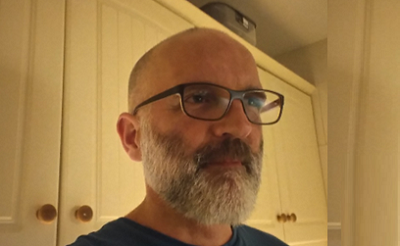
 Ali Graham is an emerging writer based in Belfast, Northern Ireland, who focuses on short stories and poetry. His fiction has been featured in Crannóg 38, and his poetry has appeared in various literary publications, including A New Belfast Poetry Map, A New Ulster, Boyne Berries, Open Mouse, Shift Magazine, The Bangor Literary Journal, and THE SHOp. He was also long-listed for the Desmond O’Grady Poetry Competition. Graham continues to explore the intersections of life and language in his creative work.
We Will Grow Flowers
By Ali Graham
I haven’t phoned work to say I’m sick for over a decade, even though I really am unwell. I’m terrified the thoughts of despair are a sign of my impending collapse; I have a head condition – consultants say no drug can cure. I’m a dead woman walking!
Life wasn’t always like this. Well, not as intense, nor with the urgency the medical profession has assigned to my case. I’ve been living my life, no different from anyone else and like all human mammalians, work is my central focus and meaning of existence – what else is there? To be in fulltime employment, gainful or otherwise, is the social norm – the shared standard of acceptable behaviour by a group.
I have worked hard all my life to fulfil the expectations of high society, and have rarely peeked under my blinkers, let alone removed them. The consequence of this, is the head condition I now own.
You see, I am poor, and always have been. I have tirelessly worked my fingers to the bone, figuratively speaking, but I never once sensed the slightest desire to be rich, or even the half of it. I believe with all my heart and hope to die, that being poor has a significant bearing on my current mental state, coupled with, the lack of, and constant yearning for time. Time has become the preoccupation of my mind. I have little or none of it on my hands and I’m convinced, if I had it, this elixir, this sweet tasting, active ingredient, then my wellbeing would altogether be enriched by the beauty that surrounds me, and the stars in the sky would surely be a lamp unto my feet. Having no time on my hands, has sickened my heart and soul. Anyhow, enough about wealth and the time one has on one’s hands. I wish to address this malaise, so I attend a prearranged appointment at my local health centre.
My doctor, of nearly ten years, echoed the consultant’s prognosis, regarding no drug can cure, and suggested that isolation may be my only hope of relief. She recommended I buy a house on a plot of land, in the countryside – throw up a high wall along the perimeter – fit a sturdy lock to a heavy gate with an intercom – and have little or no contact with the outside world. No more work stress, exposure to politicians, advertisements, religious rituals, fad diets, exercise regimes, or snake oil shopping channels. My doctor said, she often dreamed of living a life free from modern madness, but she pitied her patients and couldn’t abandon them.
I told the doctor I was broke, even though I had worked all my life. After paying the bills, I never had a penny left, so it was out of the question for me to buy a house. It may be considered ill-mannered, but I asked her if she could lend me the money, promising that I would somehow repay her. I quite liked the idea of a house in the country and, if she liked, she could come with me and help me choose a property from the estate agent’s window.
Eventually it hit me. I had just asked my GP to lend me money, to buy a house. Am I insane? Am I really that fucked up? Do people just rock up to their doctor’s office and ask for a loan? But I felt no inhibition, no ability to self-censor, every word I spoke was like the chorus from a popular song. Now, I’m worried sick that my brazen rudeness – because, on reflection, that’s exactly what it was – will cause my doctor to hate me and decide I’m a selfish, greedy, despicable human being. Now, my despair has deepened and is cemented at such a depth I am convinced I will die. I tried to gage her thoughts by the expression on her face – did she think I was insane, fucked-up, despicable?
After a brief silence, she looked over the rim of her glasses, her green-eyed gaze fixed on mine as she stood up. To my delight, she said she would go with me to the estate agent, and moreover, she would lend me the money to buy a house. I held her coat out and she backed into it, arms first, then I placed her hat on her head and handed her the long-handled umbrella from the coat stand. She waited while I opened her office door, then left, with me following her out.
We passed four rows of staring faces in the waiting room, all looking as sick as me, or worse. I took two cigarettes from the box and put one into the doctor’s mouth, then lit it for her before sparking my own. She smiled, and we linked arms to walk out the sliding doors, into the sun.
As we made our way to the estate agent in East Belfast, I caught a reflection in a shop window. I thought it was mannequins, until I turned my head and saw a crowd of people. It was the four rows of staring faces from the waiting room – faces with open mouths, crying, sniffing, grinding their teeth, and others screaming in hysterics.
“Fuck it,” I said, looking them straight in the eye, “if the doctor can find a big enough house, we can all live in it together.”
The doctor nodded to her patients and smiled, then took my hand and kissed me on the cheek. She asked if she could come to the house – to stay – to always be with me. I said I couldn’t think of anything better. I told her that I loved her, I have always loved her, and this is the happiest day of my life.
She said she loved me too, and wanted to be with me for eternity.
*
We were a group of eighteen people, gathered around the large window at the estate agent’s office. Some of the staff inside stood up from their desks, curious at the motely crew on the other side of the glass. One of them, cheeky bitch, took a landscape photo of us on her mobile phone. I watched her press the buttons, to post us on social media, and wondered what caption she would use. The doctor wasn’t happy that our photo was taken and told us to wait outside while she dealt with the matter. We watched as she approached the woman’s desk, leaned on its surface with the knuckles of both hands, and as far as we could tell, asked to see the mobile phone. The doctor and the women studied the screen and more buttons were pressed. Words were exchanged before the woman came outside and apologised. She accepted her behaviour was insensitive, intrusive, and morally bankrupt – clearly repeating what the doctor had said – and asked our forgiveness, explaining the photo had now been deleted. She produced a notepad and pen and proceeded to write Tea or Coffee, according to each person’s preference, as she consulted the group.
Gathered again, around the large window, we sipped our drinks and watched the doctor, as she flipped through a ring binder of properties for sale. She removed one of the photos, walked to the window and held it against the glass. I didn’t get a clear view of the house but like everyone else, I began jumping up and down, cheering and clapping. Tea and coffee spilled everywhere and over everyone’s clothes, but it didn’t matter. We were so happy and excited we had a new home – we could now live without the worries of the world and the doctor would live among us.
After signing various documents, the doctor walked outside to a deafening applause. We lifted her above our heads and sang, she’s a jolly good fellow, while walking up and down the path. I looked up to her face and saw a calm I had not seen in ten years. Her smile seemed more beautiful than ever.
“Ok, everyone,” she said, “you can put me down. The coach is here. We’re going to the new house.”
We shuffled our feet, to turn around, the doctor still held aloft, just as a white coach pulled up. I reached to take the doctor’s hand to help her down but another round of she’s a jolly good fellow began. Workers from the offices and shops on both sides of the road stood out of the buildings to witness the celebration. Every window, on every floor of every building, was filled with faces – one on top of the other, in between, and beside each other – a mass of blinking eyes, overseeing our departure. I watched as they paraded the doctor up and down – each one of them happy, happier than they had ever been.
The coach doors opened, and the doctor called out for everyone to board. We were last in the queue, about to step on, when the doctor took my hands in hers. Smiling, she looked into my eyes and asked how we would spend our days.
I kissed her on the lips, put my arms around her, and said, “after the builders erect the high wall and the heavy gate, we will grow flowers.”
For The Galway Review 13, Printed Edition, April 2025
 The Galway Review