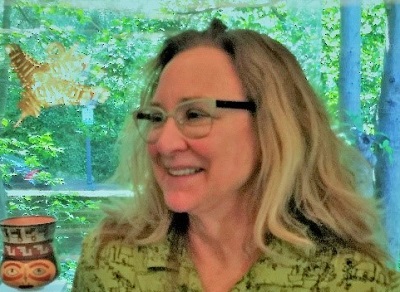
 Kathy Ellis grew up in Michigan with a river view of Canada but now resides in Atlanta. Poetry was always dancing in Kathy’s head, so she finally picked up the pen ten years ago. To her surprised delight, Kathy experienced quick success in awards, honorable mentions, publications, and co-facilitating writing groups. Kathy’s poetry collections include Primero (2016), Wings from Roots (2020). and Marvela and the Broken Waters (2023). Kathy serves as an English as a Second Language Coach/Instructor and Intercultural Communication Trainer, and she often prepares refugees in American job search skills.
Songs from Fairy Trees
Atlantic winds search the fields, bending
branches into horizontal fingers.
Fairies busy themselves when dark creeps in.
The winged creatures make fairy forts
to curl under the soft haze of daylight.
They pluck harps and sing spirited tunes
to tingle the unwitting, especially when the
fairy trees’ small white flowers smell sickly sweet
and their petals fall on dew during springtime.
As the summer sun moves on, fairies
drink their fill from the trees’ fleshy fruit,
dance in a circle,
shrill their voices,
in hopes that their lullabies
lure an innocent child or two
to the other side of the invisible veil.
Villagers leave baskets of apples and cakes
at tree trunks to appease, and perhaps capture
a rare glimpse of wee folk hiding under the leaves.
A fairy tree stands alone in the middle of an emerald field.
No one ever thinks of removing it.
Gruff farmers mind their distance
as they work the land and graze their sheep.
Generations pass along stories of fairy wrath,
sipping whiskey and tea in front of fireplaces.
Leaves change colors, and red berries
drip into wine and wisdom.
When harvest ends,
delicate songs woo melancholy and
mortals feel restless. A treacherous time
under these pagan skies,
even for the cautious.
The portal creaks,
claims the unwary
before the winter solstice, when
songs turn to groans,
beyond the winds howling off the Atlantic.
The Bedouin Horsemaster
The Bedouin’s headcover drapes
around dark strands and
over her shoulders to blend
with a green caftan. The
winds of the desert lure the Bedouin
toward the warrior horse. Beauty
and splendor roll from the sheen
of his charcoal coat and muscular quarters. A
black mane waves
like a toreador’s cape over his torso.
The stallion’s mistrust dilates
his eyes. Animal and human
scents drift under the shade of palm trees.
She smells his adrenalin.
Vapor steams from his nostrils. He
runs unbridled in the corral
under the cycles of moon.
Her pretense of indifference
walks out of the corral, sensing
where the horse trusts to be.
Tossing his head and snorting defiance,
evening breezes splay his thick mane.
As the sun rises, hooves amble in dust
toward the woman waiting.
The pulse of the horse’s heart searches
for deception. Eyes delve deep into
this Bedouin’s character. The
horsemaster’s thin wand channels energy.
They converse.
They play.
He gallops away.
He returns on his terms.
As the full moon appears, the
Bedouin waits for a signal. When
the horse offers his eyes, open and clear,
trust transforms that desert night.
Bedouin and beast ride
between saunter and trot. Tightness and
the stretch of his neck signal the next motion.
His gait elevates.
Dark wings unfold from his sides
with ease of a great falcon. Sprays
of black and jade
merge into ribbons of silver
beneath the Saharan skies of a thousand orbs.
Derwent
My father reversed his name,
from Derwent to Raymond.
“We understand why,”
everyone agreed.
Did the child ever hear,
“Derwent, shuck the corn.”
“Derwent, pass the kidney pie.”
Too late to know.
A few actors, painters, politicians
carried this name in the 1800s.
In England.
Wonder how their lives went?
Derwent names cities, gardens, parishes
in the United Kingdom.
Even a river in Tasmania.
Not so bad.
Small town America,
was not welcoming to such a name,
especially in a one-room schoolhouse of laughing children.
When my teenage voice announced
that I wanted to change my name,
my father responded
with no pause,
no insult,
no asking why,
“When you turn 18. “
Bloody hell.
I never did.
 The Galway Review