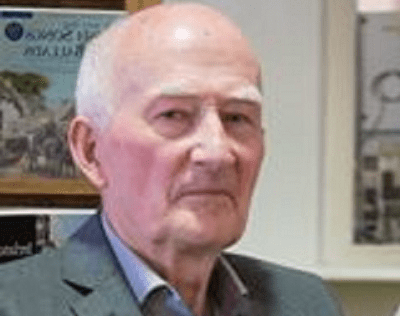
 Matt Mooney, a Galway native, lives in Listowel.
He has six poetry collections. Won The Pádraig Liath Ó Conchubhair Award.
Deputy Editor of The Galway Review. Published in The Blue Nib, Feasta, Vox Galvia, The Stony Thursday Book, The Galway Review, The Mill Valley Literary Review and in many anthologies.
A Review of Rachael Stanley’s ‘Back to Infinity’ by Matt Mooney

A Review of Rachael Stanley’s ‘Back to Infinity’ by Matt Mooney
Yes, when all is said and done it’s back to infinity with us. No choice. It’s almost as if by the title of her first collection of poems ‘Back to Infinity’ Rachael Stanley challenges us to stop and go down this by-road of meditation on our journey and our journey’s end. If we do we might emerge from it with a clearer vision of the main road ahead. Strategically the words of a poem that give the book its title is the very last line of the last poem ‘Atoms’. What strikes my mind here on reading this poem over and over, rolling it over in my mind, is how we strive to find a suitable name for a newly born child and often disagree about it but yet once the name is given it somehow becomes the child to us.
It lasts for a lifetime and beyond, until it vacates its space in infinity to another soul with another name and goes on, on the highway, forever,
‘beyond names and descriptions
beyond labels and conditioned minds,
and dance the way back to infinity’.
The poet emerges from the pages of this book as a person toying with some of the great questions of life, tossing them around as if they were lightweight and getting away with it. All of this clothed in everyday language. Her dives into philosophy, lightly taken, and what she comes up with is shared’ leaving us thinking, making us think. In ‘Farewell to Gran’ describing the impact of her death on her as a young child she says:
‘Silence first made itself
known to me as absence
Now it makes itself
known as presence’.
You could say there are words of wisdom in her philosophising as well as more than a slight strain of existentialism (after all she is a follower of TS Elliot):
‘Be careful of the self
that lies hidden in the soul
befriend its bitter essence
before you get too old.’
and again in this wakeup call to those of us who are in the grip of our mobile phones and social media, fearing the results of self analysis in ‘This Self’, a poem written in solitude,
‘And then the walls of my fortress
come crumbling down,
Alone with no distractions left
I find this very self I can’t escape from’.
Indeed she singles out the mobile phone which has become an extension of the human psyche in a section of poems which she calls ‘The Beast’. One of them ‘Crutch’ pulls no punches in the lines in which she gives us her summing up of it as it appears to her as:
‘Solace from the loneliness
of having nothing
to say to each other’.
The poet gives all of herself in these poems and it’s never not the time for writing whether it be while peeling potatoes or doing the ironing and for a first collection she is quite daring in tackling the concept of infinity, of life and death in the one breath. The philosopher John Moriarty in quoting an old woman from West Cork tells us that, ‘the dead aren’t even the width of a spider’s web away from us’. Rachael says about her brother in ‘Joe’:
‘You live on as
invisible presence, our
guiding light beyond
the veil of life and death’.
She expresses our powerlessness in the face of death in her reference to how the family felt when Joe was shot in Zambia:
‘It seemed as if we failed you
in our powerlessness to prevent
that fatal bullet as you fell
in the noon day Zambian sun’.
In her poem ‘Drowning’, probably based on her grandfather’s tragic death, there is great pathos and even terror in:
‘The cry of the drowning
falling on the deaf ears of the wind
falling into the abyss of gigantic waves
falling out into days and nights of eternal silence’.
She sees the stark reality of death first as a child in the silence surrounding her Gran’s waking but in nature in ‘Winter’ she sees more of the same and reflects on it, connecting with the earth as Moriarty has advised us to do. In her poem ‘Winter’ she is surprised to find beauty in the bareness and starkness of a tree:
‘like an exotic piece of sculpture
you spoke to me that day,
Hey you, wake up! You’ve never
seen me like this before’.
It’s in her poetic forays into nature that this poet shows off her craft to good effect in the way she gets into the heart of things, taking us with her, clothing her findings in rich imagery, painting pictures that stay with us delightfully:
‘You take me down to your depths
to your bed
where you sing your timeless tunes’.
Or
‘Like bride and groom
apple blossom and evergreen
flirt under a blue canopy’.
A mimosa tree ‘fulfilling the promise of Spring’ takes her by surprise, shows her irrestibility to the pull of nature:
‘And then you pulled me like a magnet
across the chilly February street
to stand in wonder’.
There’s compassion and a deep understanding of how people struggle for survival between the covers of this book too. She shows it in her poem about a Kenyan mother trying to care for her children in famine and drought conditions,
‘today she will walk many miles
of this scorched earth
to haul water
to carry firewood
to pray for rain
to hope with each step she takes
that help will come, that just for today
she can feed her children’.
In skipping along to one of her poems that has stood out for me I want to mention her poem ‘Liberty’ because for many it resonates in its closeness to the bone these days of unending wars.
She uses personification very cleverly:
‘I saw the hunger in the human soul
the suffering of those in chains
for I had planted this longing
in their hearts’.
In the final stanza there is a strong message that make us reflect on what inner freedom really is. We could do worse than giving some thought to her epigraph above her poem by Lao Tzu, ‘He who conquers others is strong. He who masters himself is mighty. She does.
‘but they do not know me at all
for they made me in their
own image and likeness’.
When I got to the poem I call ‘Gethsemane’ I downed tools and cried, overcome by its power. It’s full title is ‘Remembering My Father As We Approached Gethsemane (Friday April 13th 1979)’. Even the day and date of the month seems fateful. Here the poet hits us for four with her honesty in the narration of her father’s life and his part in the family relationships:
‘While you as an angry man raged at life’s ills
my mother silently fumed at a world that
asked her to shoulder its burdens’.
But the sheer emotion and sadness engendered in both of their hearts as she accompanied him into the Meath Hospital, buried in these lines, will bring tears to the eyes of many, and with all that there is inside otherwise, makes ‘Back to Infinity’ a little beauty for me:
‘and I tried to avoid looking into soulful eyes
you were forlorn in your brokenness’.
Of all Rachael’s fine punch lines, the following from ‘My Last Day’ is one of the finest:
On my last day,/ I hope to be a feather/ falling lightly upon you.
(Published by Revival Press 2024).
 Rachael Stanley currently lives in Milltown, Dublin grew up in Rathgar and went to school in St. Louis in Rathmines. From a young age, she’s always had an interest in expressing herself through the written word. Her poems have been published in Drawn to the Light Press, A New Ulster, Riposte, The Blue Nib, Live Encounters and many other journals and anthologies. She was commended twice in the Francis Ledwidge Poetry Competition. She had a short memoir piece published in the Irish Times in 2016 and some years prior to that a travel feature in U Magazine. She is a nature lover and loves to walk by her local river, the Dodder.
 The Galway Review