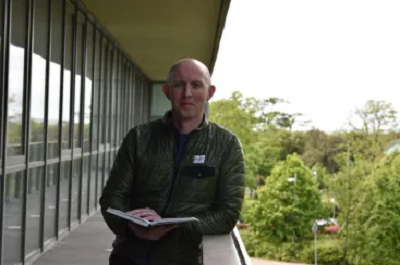
 Eoin Flannery is Associate Professor of English Literature at Mary Immaculate College, University of Limerick. He is a graduate of the University of Galway and the University of Limerick, and he has taught at universities in Ireland, the UK, and Canada. He has published 12 volumes of literary criticism on Irish poetry and fiction, with a special focus on ecopoetics, environmentalism and postcolonial studies. He is currently working on a poetry pamphlet entitled, Unshadow, as well as a further book of criticism on contemporary Irish and British poetry.
‘Overstories’
After Richard Powers
The copse offers itself,
unfurls its branches, though
we are not here.
Our approach is betrayed by
the earth pulses of heavy
treads, roots tracking shadows
on the shoals of
mosses, and twigs, sheddings from
the bodies that loom over us.
Unopened ground, the timbre of early growth,
shoots ringing with the end of hibernation,
dark vessels creep and
await to be heard, lifted up and out,
reap the bright light
of the new season raining
its warmth.
The flock explodes, barely on fire,
barely alight.
Stripped of its bark, naked sinews alight
with story and voices,
voicing the soil,
the pooled soil voices,
unwilted and crossbred.
The floor is ablaze, cleansing itself,
shaved peels of life brushed up,
sideswept from full view.
Rustling flies and swoops at us,
takes our measure,
seeds us with its losses,
its rebirths –
roots us.
‘Galway – Albania, 1999’
The afternoon sun blinds, hides you,
so that I can only imagine you now
take a seat on the bus that thrums out
its filthy clouds onto the simmering concrete,
as it pulls away from the station,
a slow hauling of time.
I scan the moving windows,
dark as mine-shafts,
and life contracts to your hand
on the glass,
to the stumble of an uncertain
glance that we can never be sure was returned.
A pleading look,
lost in a culvert between us.
The window is rich
with the swirls of your finger-prints,
embossed with the prospect of loss.
Tyres twist and grate on the summer tar,
digging at the road,
before the bus makes its way
downhill and staggers into lost time,
out-shadowing what we thought was normal,
what we thought was just another silent,
temporary departure.
The streets dilate and contract,
burning bridges to another life,
ebbing pathways that might drag us
out of reach of each other,
snag us on their retreats.
This is separation as drowning,
suspended in parcels
of tears, with the thinning out of the day
and a confusion that drifts in to obscure.
I walk, looking for your handprint,
and a cold feathering bleeds inside me,
unclasps your hand,
unsheltering our palms.
‘Germany’
I sift the face of a photograph,
prospecting the albums of the past.
Prague streetscape, a mild, bright day.
Cobblestones braced with tram-lines
that are vaulted by a shabby
cluster of students.
Locked in a conversation coursing
across the stations, the bars and the parks of
southern Germany.
This threnody is served in a private language,
a different key,
oblivious to the rhythms of these cities,
whose corners are nothing more than backdrop –
so that the world recedes from importance,
cannot impair the innocence.
Until we dive as one into a crowded
swimming pool,
slough off the heat of the brewing thunderstorm
with a plunge into deep water,
hit the floor with fingertips and closed eyes.
Floating in the welcome envelope of silence,
this is a still life.
It is as clouded yet as clear as any of the images
that archive our youth.
Then, legs begin to kick for the sky,
gasp for the noise of the daylight.
There is no need for a headcount,
we all know that only some return
to the surface.
The full abiding laugh,
unsoftened by loss, buried,
but not forgotten.
 The Galway Review