 Felicia McCarthy is a poet living in Dublin, Ireland. She is a member of Irish PENN and a Creative Writing facilitator in Fingal and dlr.ie libraries. She holds an BA & MA from Trinity College Dublin and an MA in Women’s Studies from UCD, with a thesis on Eavan Boland. In 2020, she was The Blue Nib’s North American Time Poetry Editor.
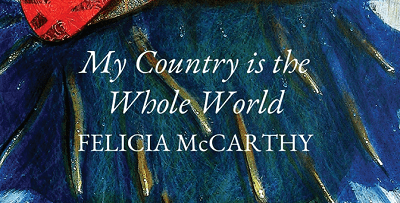
“My Country is the Whole World” Felicia McCarthy (Salmon Poetry) – book review

Felicia McCarthy is caught between two countries, USA and Ireland, and writes in her introduction that she feels she is “a woman of two countries, and a woman who belongs to two worlds; the one we live in now that is under reconstruction – a winter transition, perhaps – and the one that is growing within this one, a kinder and more equitable world.” This isn’t some sweet sentiment, but an idea born in knowledge of Irish history and watching grandchildren grow up. Unsurprisingly the first poem, “Climate Justice”, explores what world those grandchildren could be growing up in. It ends,
“In the blue dark morning
the red light of Venus
signals a warning.
At dusk a mist rises
to hide the setting sun
from the change and loss
we must now weather
together.”
There is (just) still some time for humanity to band together and save the world. The choice of the word “justice” is interesting, it implies a future for everyone, not just those who can take the short-term route and buy their way out. Justice looks for a long-term solution, one that includes women, in “Because you listen”,
“Because you listen to the poets, we come
together to talk about science, words, and remedies
and women’s work of watching, keeping things
going. We have some experience with patience.
The wolf boys cry out and hoard supplies.
the elders, particularly the grandmothers,
gather curing weeds and heirloom seeds,
and prepare to call everyone to the table.”
It takes the patience of women, tasked with keeping families going, keeping traditions and histories alive, to gather plants and seeds necessary for the future. The boys’ supplies will run out. The women are planning for sustainability.
Seeds are a theme in “Pomegranate, A Revision” which ends,
“Nine seeds consumed in the dark
was enough cause a cleft in the earth
with time left for the daughter to find
her lover in the underworld.
Ceres settles by the hearth to rest,
trusts her daughter and years of
good mothering. Persephone returns
a woman, pregnant with Spring.”
The poem also concerns two worlds, Persephone caught between Hades and earth. But it re-writes the myth and makes this splitting of time Persephone’s choice. A means of spending time between her mother and lover, connecting a new family with the old and holding generations together.
The idea of leaving home to maintain a home re-surfaces in “Full Circle” which opens with the idea “I am from corn, hot Iowa miles of it, and the smell of ether” and ends (Gorta Mór is the Great Hunger or Irish Famine),
“I am from among her effects: the loose powder box of pasteboard
stuffed with old letters. My dearest Girl, I read, and Dear Grand Girl.
I am from tenant farmers on Mayo’s Foot of the Reek
to McCarthy’s farm on allegheny’s Black Creek, finally
returned from the forced migration known as an Gorta Mór.”
It acknowledges and celebrates the link between American and Ireland, that one person isn’t an island but seeded by ancestors even if families have to leave their country of origin. In “The Ancestors”, past family members are reluctant to leave, “they show up in the chins and the eyes of our children./ there is no end to their desire to return, make things right.”
“Mea Maxima Culpa” turns its eye to the Church and abuses it covered up,
“There is silence from one small god of men
as he removes the red shoes of the Fisherman.
two popes now live in the Vatican, both deaf
and silent to testimony. Paedophile priests roam
free to feast like wolves on the lambs of God,
the innocent children of church faithful.”
Of course, the abuse isn’t just restricted to the Catholic Church, but while people cling to status and power, it won’t be resolved. Later poems carry a quiet optimism. “Let Morning Come” has a prayer-like feel,
“Let the gold disc deliver on its promise.
Let the wind come up. let the fishing boats
sail from safe harbours. Let morning come.
Let it come, as it will, and don’t keep
yourself back. The world begins
fresh each day, so let morning come.”
The wishes are simple: warmth, food, security, to be able to sustain life and look ahead. A theme picked up again in “Precession of the equinoxes”,
“There was always going to be a reckoning.
inhale, exhale, examine the ebb and flow of tide.
Watch the moon’s effect on the water, on your
changing energy, thoughts, your pride.
The fall and rise were written in at the start.
We make theatre, poetry, and art from the pain
of misunderstanding the bigger picture.”
There’s a wisdom here, an acknowledgement that humans aren’t perfect, but those imperfections can still be made to work to forge connections and understanding. It asks us to see the bigger picture, to shrug off petty concerns.
“My Country is the Whole World” explores finding paths and connections, between the past and present so that a stronger future can be created. McCarthy asks readers to accept their ancestry and its cultural baggage while also seeing the connections we have with others. Her concern is justice and peace, to share the world’s resources rather than hoard them. The poems have a gentle but persistent rhythm and language, offering mentorship, not didactic hectoring. McCarthy invites readers to consider and be open to our own vulnerabilities.
“My Country is the Whole World” is available from Salmon Poetry.
Emma Lee’s The Significance of a Dress is available from Arachne Press. The link also has a trailer featuring the title poems and samples of some of the poems from the collection. It is also available as an eBook.
Featured in the Top 10 Poetry Review Blogs on Feedspot.
 The Galway Review