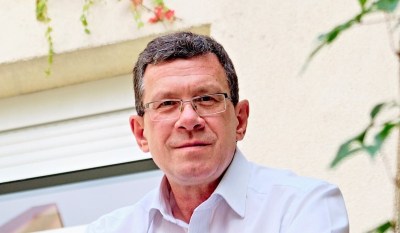
 Leslaw Nowara was born in Gliwice (Poland) in 1963. He is a lawyer by education, a graduate of the Silesian University in Katowice.
He is a poet, aphorist, columnist and literary reviewer who made his debut in the literary press in 1983. He has published ten volumes of poetry: Green Love, House of Green Windows, The Third Eye, Russian Roulette, Cocoon, Quietdark, Dot and Line, The Dark Side of Light (selected poems), The Whale’s Bone; The flood is yet to come; and four volumes of literary miniatures (aphorisms and epigrams): The World According to Ludek, The Big Little Ludek, Sentences with a Dot, and Ludek the Fatalist.
A member of the Polish Writers’ Association, he lives in Gliwice (Poland).
A Man Sick of Cancer
When I was a child people usually died
of a heart attack or cancer
Such a man with cancer
unlike one who died of a heart attack
sometimes lived quite a long time
Although it is arguable
whether he really lived for such a long time
or rather for such a long time he had been dying
So just such A Man Sick of Cancer
I really wanted to see live at least once
before he would had even wrapped himself tightly in the coffin
and had time to sink into the ground
Such sick people
were treated then with radium phosphorus and strontium
And I had a watch
with phosphor-coated hands
that glowed after dark
and I wondered if a cancer patient
glows in the dark in the same way
For these sick people
there was a red brick hospital in Gliwice
Sometimes I sneak there in the evenings
and standing on tiptoe
stared at the dark windows
I stood there for hours
hoping
that some sick person
would eventually appear in one of the windows
and just like the hands on my watch
will shine
breaking through this darkness
Airfield
The gliders I saw for the first time at the Gliwice airfield,
did not look at all like chicks thrown out of the nest,
rather like an auntie in a clearing, lying sideways on a blanket and propped up on her elbow,
because with one wing they were leaning on the grass in just such a way.
And the other wing like a finger pointing skyward
looked like the hand of a drowning man vainly calling for help.
From time to time I saw these gliders
over Sikornik and Trynek districts, circling like starlings and terns over a pond.
And there was no myth in it, no legend or magic,
none like Gryphus or Icarus, none like Żwirko i Wigura legendary aviators
none like famous 303 Squadron known from the Battle of England.
And by the airfield itself there was just a coal depot, a sawmill and a fish wholesaler.
Three barracks in three muddy yards.
After a night’s sleep, the whirring of the engines on the fishing boats could not be heard at all
from the fish warehouse,
but only the monotonous wheesizing of the refrigeration unit.
No groans of beech and pine trees came from the sawmill,
Only the barking of the dog at the shed and the screeching of saws could be heard.
It was only with the coal store that things were different
and any coachman would have sworn
that the coal carts passing the airfield barely touched the ground there
and you had to pull the reins with two hands with all your might,
so that the wheels of the carts did not completely detach from the road.
The horses had not yet grown any wings,
but on their backs, in the area of the withers,
the first stakes and quills were already visible,
and in some geldings and mares even whole flags of feathers.
The Cracow Square
The Cracow Square had as much in common with Cracow,
as Ponds Street,
where my childhood used to run around, in shorts and trainers,
had in common with ponds.
From this street to the square
was just over a hundred metres away,
but the busy Wrocławska street
to this square..defended the children’s access.
From a small hill overgrown with bushes and grass,
which must have been a bunker during the war,
we used to see crowds on this square,
armed with banners and placards,
who were forming for the May Day parades.
Every year in October, the square was invaded
by cannons and tanks
and we saw marching soldiers,
who lined up in even ranks,
chorally raising shouts
and firing salutes.
And although all mentions of this
have been ripped from the city chronicles
perhaps on this square
several hundred years earlier
were burned at the stake
for heresy and witchcraft?
Perhaps then, Dear Czesław*,
Campo di Fiori
was not in Rome at all,
but right here,
in Gliwice,
in The Cracow Square?
And here, in this square,
still after centuries,
you would see the ashes
on the bushes and trees,
and maybe even felt
the heat of the pyres
and the burning bodies stench?
—————————————————————-
* “Campo di Fiori” is the title of one of the best-known poems by Czesław Miłosz, winner of the Nobel Prize for Literature (1980). Located in Rome, Campo di Fiori Square is known as the place where the Italian philosopher Giordano Bruno was burned at the stake for alleged heresy in 1600.
The list
Halfway between Cistercian Abbey in Rudy village
and the Duke’s Castle in Racibórz city
is the Łężczok nature reserve with a viewing platform
on which one has to climb a wooden ladder like on a hunting pulpit.
I come up to the railing, rest my elbows on it
and look around silently
The breeze is ruffling the fur of the lake
which rustles like a cat on newspapers sharpening its claws
dragonflies blown by the wind like soap bubbles
hovering over the calamus like shreds of cobwebs
woodpeckers are screeching in the trees behind my back
toadstools and water frogs squawking underfoot
between the lake shore and the shrubby island
ducks and swans cover themselves in the shadows of the wings of grebes and cormorants
All plants and animals are protected
Trees, shrubs and flowers are protected
Birds and reptiles and amphibians are protected
Mushrooms are protected
All insects are protected
I can read their names
This is a long list of endangered species
This is a long list of protected species
Is it a list of those freed from starvation?
disentangled from suffocation in snares?
pardoned from being shot?
I read the entire list three times carefully
and I check carefully
whether I am not on that list like others?
 The Galway Review