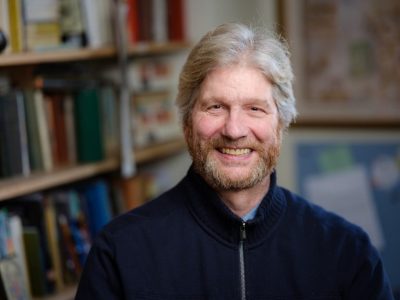
 Director of Wake Forest University Press and Professor of English at WFU in North Carolina, Jefferson Holdridge is the author of two volumes of poetry, The Sound Thereof (Bradford UK; Graft, 2017), and The Wells of Venice (Eugene: Resource, 2020). He has been published in Prairie Schooner, Poetry Ireland Review, Southword, The Irish Times, The Anglican Theological Journal, Mantis, The Christian Century, The Quint, Honest Ulsterman, and Poetry Wales, among other venues. In 2017 he co-edited and introduced Post-Ireland? Essays on Contemporary Irish Poetry with Brian O’Conchubhair (WFU Press). His most recent critical work was Stepping through Origins: Nature, Home, and Landscape (Syracuse, 2022).
For a Weeping Cherry
Now a memory lingering in an empty space.
A veil removed from the flower bed
That gives surprise to the house’s face.
For it sees everyone as would a nude
Suddenly looking at the viewer, like Manet’s
Olympia when the model turned her head.
The not ideal first critics thought it rude,
But our cherry adorned a milder gaze
Since moving here and shall be missed.
Strange that the year the tree had died
(As though the time had come to insist)
It had more flowers than many springs before,
Or was it, as often, the season knew and lied,
So once blooming the tree would weep no more.
Humanity
The donkey brays and reminds us we are trapped
In a body that hangs more heavily upon us
Mocking our stance as we look over the wall
And watch the flocks that pass along the road
Like one of Odysseus’s men whom Circe
Turned into swine.
Though this man was tapped
For being too stubborn, making a fuss
Just as one who charged at a goad
Became a goat.
The men who’d eaten all
The food became the pigs they were, but wise
Odysseus did not. What type of man was he
That the enchantress loved and wouldn’t touch
With her awful magic, transforming desire
Yet desirous to hear its dangerous song?
In the end he must have known as much
Before he left Ithaca for decades long.
Only his dog and nursemaid would recognize
His scent and scar before he’d fire
The many arrows that filled the hall with blood
He and his son claiming their humanity.
While among the hills of Italy
Early morning having stargazed in the mud
This donkey sadly questioned what he’d done
And braying complained that now he had none.
Butterflies and Moths
We are two butterflies that circle
And scarcely seem to touch, who are focused
On each other as they weave along the hill
And through the wires carrying years of rust,
Or we hover like the nib above the page.
Our love letters are written and we’re not
Sure how to finish this chapter of our age.
While claiming our spheres, we continue to glide
Held by gravity to keep the course we plot
Like astronauts orbiting a long time inside
The capsule, watching the moon, Venus, Mars,
As moths are led by both the pull and light
Of something that both is and isn’t ours.
Our circles are guided by one another’s flight.
Compostable
Something that disposed of helps things grow,
That rots, breaks down, returns to earth.
A closed system of increase and decay
Decay and increase. As stinkhorns blow
Corpses draw flies, the miraculous birth
Of mushrooms and parasites, like us from clay
Or dust in the hands of the maker.
Anything organic, even rock-hard stone
Crumbles eventually. Non-compostable alloys
Like plastics are eternal. In the glare
The graduate hears “plastics” with a moan.
The future hangs lifeless among useless toys
A utopia, like all others that are inorganic,
Cluttering the planet and making us sick.
 The Galway Review