 Steven Cornelius was born and raised in Northeast Mississippi and is married to a beautiful, auburn haired second generation Irish woman with deep roots in Galway and Sligo. His love of books began at a very early age. When night fell on the farm and chores for the day were complete, he and his family sat around the fire and read until bedtime. Many of his childhood adventures are featured in his writing. He attended the University of Mississippi, earning bachelor’s and master’s degrees while participating in Air Force ROTC. Steve completed more than thirty years Air Force service in the US and overseas. For the Distant Traveler Trilogy, he drew upon experiences and memories collected during assignments around the world. After retiring in 2015, Steve decided to get serious about a lifelong passion for writing. His most recent work has been published in Mississippi magazine (October 2022) and Louisiana Living (November 2022). He just finished a multicultural novel set in Cuba and Houston Texas featuring Hispanics as the main characters. Steve has written one hundred and five short stories collected in two volumes and posted stories on the Mississippi Folklore and True Appalachia webpages and has a following of more than 3,000 regular followers on each page.
Donegal
By Steven Cornelius
After a smooth and enjoyable three hour ferry passage across the Irish sea from Holy Head, Wales to Dublin Seaport, Ireland we heard the hiss and crackle of the ferry public address system giving the long anticipated “prepare to disembark” announcement. My wife, son and I following a thousand other passengers down four flights of stairs, stepping out onto three wind whipped car decks, frantically piling into cars and vans to escape a biting wind straight off the Irish sea. Once inside our cold but quiet SUV, I sat nervously, fingers thrumming on the steering wheel, impatiently waiting for the signal to start engines and get some heat blowing inside our cold soaked SUV. No one could move off the thousand foot long, one hundred foot wide Kelly green and white vessel until one of the crew signaled it was safe to do so. A ten minute delay seems much longer when you’re sitting in an automobile cold enough to see your breath. Finally, the engine start and movement signal came; I followed the attendant’s hand signals and nosed our white SUV off the ferry, staring straight ahead while nervously trying to ignore a sixty foot drop into dark green water on either side of that shiny, rain slick hundred foot long black metal ramp. We were relieved to depart the massive people and vehicle carrier that had taken us from Wales to Ireland; my squeamishness while we were at sea proved once again that I’ll never be a blue water sailor.
Once off the ferry, it took about thirty minutes to clear the Port of Dublin. We weren’t the only ones scrambling to produce passports for an immigration check before being waved through the heavy, day-glow yellow security gate. Weeks before, sitting in the comfort of our Tennessee home, I had planned our arrival for a Saturday night, thinking the weekend would mean lighter traffic through the big city. That absolutely wasn’t the case. I cursed under my breath, dodging heavy traffic as we twisted and turned our way through Dublin’s crowded urban center. To make matters even more stressful, directions from the built-in GPS in our rental SUV consistently arrived on the display about a half-mile after I needed them, forcing me to make several sudden lane changes and banzai turns through traffic roundabouts. My sudden, rash movements caused many startled Dubliners to lay on their horns and shout, “Welcome to Ireland!” while flashing strange and unique hand signals in our direction…at least that’s what I assumed they were saying and doing. Finally…mercifully…the GPS indicated that we were less than a mile from our bed and breakfast in Dublin’s southwest suburbs. I slowed to a crawl and turned down Brighton Street. To my astonishment, we found a parking spot directly in front of St. Aiden’s Guesthouse, our hundred-year-old lodgings. Given our experience with nonexistent parking since leaving Heathrow Airport, this was an amazing and unexpected stroke of good luck.
I quickly wedged our small SUV into the empty spot and didn’t move the car again until three days later, the morning we departed, using taxis instead to move around the city. We spent three enjoyable days in Dublin but after trudging for miles through city center and the Trinity College campus, we were beat. The afternoon before we left for Ireland’s Atlantic Coast, we were again walking along Pearse Street near Trinity College, dodging a million other pedestrians, dog tired and ready to head back to our rooms. We stopped on the corner of Pearse and Nassau, eyes watering from a strong, cold wind, waiting for the little green man to yelp that it was safe to cross the busy intersection. I glanced at my wife and son, asking, “Y’all ready to head back to our rooms? Tired expressions and nods from them told me all I needed to know, so I stepped away from the shelter of the building we huddled under and waved down a passing taxi, relieved that the driver saw me and pulled to the curb. Once we were squished inside the narrow and cramped backseat, I leaned forward and told him our destination. The driver nodded, pulled into traffic, glancing in the mirror as he asked, “Where in the states are ye from?” We called out, “Tennessee” in unison. After a few minutes of conversation the driver asked, “Where are ye off to next?” I quickly rattled off, “Galway, Sligo and Donegal.”
The driver smiled and nodded vigorously, “Oh, that’ll be a fine trip.” He then offered up places to eat in each city. He and his wife had celebrated their fortieth wedding anniversary a few months earlier at a beachside resort hotel and spa near Mullaghmore Head, twenty miles north of Sligo. As he talked, I made mental notes about a steakhouse in Galway, an Italian restaurant in Sligo and his repeated insistence that we see the Cliffs of Mullaghmore Head en route to Donegal. The driver dropped us directly in front of our B&B and after I paid him and offered one last waved as he drove away. The next morning, anxious to get underway, we filled every nook and cranny of our SUV with luggage and stuff bought in Dublin and were off, plunging headlong into those mutual suicide pacts known as Dublin traffic circles. Navigating those islands of mayhem caused my wife to gasp and close her eyes and my son Dan to grip the door handle on his side of the car hard enough to leave a permanent imprint. We spent almost an hour creeping through bumper to bumper traffic before breaking free, exchanging the bustling beehive of west Dublin for the open spaces of the Irish interior…what a wonderful and welcome relief! About a hundred miles west of Dublin, we began to see signs for the town of Tullamore and the prospect of distillery tours. We had several hours to kill before we could check into our room in downtown Galway, so I exited the westbound lanes of M6 and turned toward Tullamore, except that I took the wrong exit off the traffic circle and headed northeast away from Tullamore…toward the tiny village of Kilbeggan.
Sometimes a wrong turn in a strange town is just a frustrating pain in the ass and other times a couple of miles in the wrong direction leads to a completely wonderful experience. This detour was a delightful diversion for all of us. We crossed the river Brosna, drove into the village, slid into a parking spot near the Kilbeggan Distillery and followed signs promising “The Kilbeggan Distillery Experience.” Unfortunately, the place was locked up tighter than Dick’s hatband and not a soul in sight. We’d arrived about thirty minutes early. To kill time, we walked a few hundred yards up the road, looking over a fine old brick building on the distillery grounds. I took advantage of unexpected sunshine to snap a dozen very nice photos of the village, distillery and mill race with bright red water wheel. As we walked along the river Brosna, I noticed a small chocolate shop a hundred yards away with signs promising coffee and hot chocolate.
 Locke’s Whiskey Distillery, Kilbeggan, Ireland
My wife doesn’t need many things to make her happy, but a good cup of coffee in the morning is near the top of that short list. She’d had one cup of convenience store coffee two hours earlier and the most complimentary thing she said about it was, “Well, it was hot.” Hoping to get her something a little tastier, we headed for the shop. As we drew near, I was relieved to see the lights on inside the small shop and a rectangular blue and white “OPEN” sign over the door. We stepped inside just in time to hear footsteps on the stairs as a middle aged lady descended, leaning over the railing and offering, “Dia duit, maidin mhaith,” in Irish. Seeing our puzzled looks, she quickly switched to English, saying, “Hello, good morning.”
After taking our order for coffee and hot chocolate, she disappeared for a time while we took a seat next to a lukewarm radiator and large rust stained grinding mill with a pile of dark brown husks under its discharge chute. I looked the machine over and concluded the shop owner used it to grind coffee beans. After a few minutes, the shop keeper popped her head out of the kitchen, looking at me as she asked, “Milk or dark chocolate?” I reflexively replied, “Milk.” The proprietor nodded and again disappeared. A few minutes later my wife was served a fine cup of coffee and I enjoyed the best cup of hot chocolate I’ve ever tasted, bar none. Before we left her shop, I asked about the streaked and stained mill we’d been sitting near and was astonished to learn that she used it to grind cocoa beans imported from Africa and the West Indies, turning the coarse powder the mill produced into chocolate bars and other confections, which, by the way, made the little shop smell wonderful. An hour later, we walked back across the fast moving river Brosna toward our SUV. As we passed the distillery, staff were finally unlocking the doors, but by then, the enthusiasm for a tour of their fine establishment had faded. We had mentally moved ahead, preferring to spend the remaining daylight hours exploring Galway.
Galway and Sligo came and went in a pleasant blur and four days later we were headed north on the N15, dodging wide-tired, muddy farm tractors taking up the whole road as they came at us and stressing over frustrated wannabe Formula 1 drivers tailgating our little car; crowding us because I refused to drive faster than prudent on unfamiliar, narrow little roads. To allow traffic to pass us, we stopped by WB Yeats grave for one more chance to pay our respects. We were anxious for coffee, tea and some breakfast, and had spotted a small café, with an open for breakfast sign a mile or so back. So, after standing in front of Nobel Laureate Yeat’s grave for a few minutes, we again piled into our dirt colored SUV. The little car had been a wonderful, shiny white when we picked it up at the rental agency, but now was an unattractive brown, streaked with layers of muck accrued driving across rainy swaths of southern England, Wales and now Ireland. We parked and strolled toward the small café; my wife was doubtful, but I noticed a young woman inside. I pushed the door open, surprising her. She jumped and put a hand to her chest. I apologized for startling her and asked, “Are you open?” She shook her head, “Not for another hour.” I glanced at my watch, it was almost ten AM…when in the world did these folks eat breakfast and lunch? I quickly added, “We’re not looking for a hot breakfast, only coffee, tea and scones.” She smiled and nodded, “Okay then, I can fix ye up.”
As we sat sipping hot beverages and nibbling on tasty scones smeared liberally with local butter and strawberry jam, I shivered and looked around wondering why the little place was so cold. It finally dawned on me; they weren’t open, so no one had turned on the heat. I sat about ten feet away from the young woman and her husband as they worked in the kitchen prepping for the day’s customers. I smiled as I watched her husband hug his young wife and tell her, “You know I’m just crazy about you.” I reached over and patted my wife of forty-nine years’ arm and smiled, causing her to give me a puzzled and questioning, what are you up to look. When I walked up to the serving counter to pay, the pretty young woman asked me, “What brings you to this part of Ireland?” I pointed back at my once auburn haired, Irish wife, “Researching family roots and visiting WBY’s grave.” She smiled and nodded. I suspected that many folks passed through their small establishment and when questioned, offered similar answers. We waved goodbye and two minutes later were once on the N15 headed toward Donegal. We wanted to walk the city and look over as many of the famous Donegal Tweed products on display as we could before heading on north to our B&B reserved for that night.
Before we made it to Donegal, my wife wanted to make a short side trip to Mullaghmore Head. A bit out of the way, but well worth the effort. The cliffs were everything the cab driver back in Dublin said they would be. As we parked and stepped out of the car, we were astonished to see a number of hardy older men and women striding by, heavily bundled up, heads bowed against the cold Atlantic wind whipping mist off the surf. Bitter cold wasn’t going to keep them from their daily walk! Thirty minutes of driving later, we had warmed up enough to tour the famous Baleek pottery factory on the river Erne before pushing along, bearing down on the city limits of Donegal. As we slowed and crept past the southside harbor, we applied hard won knowledge and turned into the first public parking lot we ran across. Finding quick and convenient parking anywhere in England, Wales, Ireland or Scotland is rarer than a Yeti sighting, and no I don’t mean the ice chests that are in such fashion right now. Idling into an open spot, I noticed an older woman approaching my side of the SUV. I rolled down my window and she asked, “How long are ye staying?” I paused, “A couple of hours, no more.” She handed me a prepaid parking card, “This one has almost an hour left, you’re welcome to it.” I took the card and offered her a sincere, “Thank yew very much.” She shook her head at my Tennessee twang, smiled and walked away. The generosity of locals while in Ireland always amazed me. We made our way into the city center and after lunch, found an upscale clothing store to explore.
My wife drifted into the women’s section while I was drawn to a collection of men’s coats, sweaters and other goods. I stood examining an exquisite black and grey wool herringbone weave overcoat with a dark crimson satin liner. It was a beautiful and elegant piece of craftsmanship, almost too fine to wear. I was quickly falling in love with the coat…until I fished around inside the left sleeve and found the price tag, 795 Euros! I stood shaking my head in disbelief, still fingering the soft wool, when a blonde salesclerk headed my way, leaned in and whispered, “Don’t let the price put ye off, it’s massively discounted, almost sixty-five percent.” I nodded and glanced over my shoulder watching as she walked away. The pretty young lady was wearing skintight black leather pants, a heavy gold chain over a black turtleneck and a green tweed waist jacket, all clearly intended to accent her hour glass figure. I shook my head at the incongruity of the image, black rockstar leather pants and a cascade of gold jewelry worn by a young woman without an ounce of self-consciousness about her figure or outfit, working in an upscale clothing store in a small town on the northwest coast of Ireland.
We left Donegal just in time for a rush of students leaving school for the day to slow us down as we headed for the B&B room I’d reserved for the night. Finding that B&B in the rural north Ireland countryside turned out to be as frustrating as searching for a platoon of leprechauns. We finally found the place after two hours of crisscrossing, backtracking and cursing, but more about that in another story. We also left Donegal without buying a single stitch of wool goods or anything else, which brings up a point of advice for fellow travelers…when you see something you like, buy it! Don’t put off doing so until later, because you may not find it again in the next town or the next. A couple of days later, after wearing our feet out walking downtown Glasgow, Scotland, we sat in a hotel room near the ruins of a 2200-year-old Roman bath house and bridge.
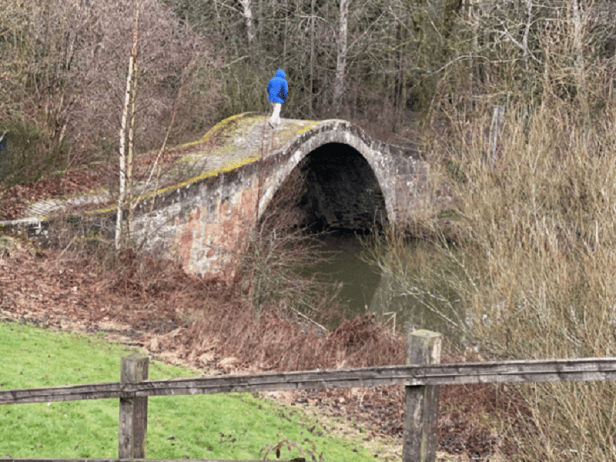 Son Daniel crossing a 2200-Year-Old Roman Stone Bridge
And we looked at each other as that bitter realization dawned on us. We talked wistfully of the nice, small-town crafts we’d seen in shops all along the west coast of Ireland, but the opportunity to grab them up for family was long gone. So, while we sat watching local TV, I did what any responsible parent would do in that situation, I pinched a plug out of our son Daniel and told him it was all his fault.
 The Galway Review